

You found the car. You love it. You can almost smell the new interior.
Then the dealership pulls your credit score and everything gets awkward.
Knowing what credit score you need to lease a car before you walk into that dealership can save you a lot of embarrassment — and a lot of money. The answer isn’t a single number. It’s a range, and where you fall in that range determines not just whether you qualify, but how much you’ll pay every month. According to Experian, the average credit score for someone who leased a vehicle in 2024 was 736. But plenty of people lease with lower scores. Here’s exactly how it works.
The Short Answer: What Credit Score Do You Need to Lease a Car?
Most dealerships and financing companies use these tiers:
| Credit Score | Tier | Lease Approval | What to expect |
| 720+ | Excellent / Tier 1 | Yes — best terms | Lowest monthly payment, lowest down payment required |
| 680–719 | Good / Tier 2 | Yes — good terms | Slightly higher monthly payment vs. Tier 1, still competitive |
| 620–679 | Fair / Tier 3 | Maybe — higher cost | Higher monthly payment, may need larger security deposit |
| 580–619 | Poor / Tier 4 | Difficult | Most captive lenders will decline; some third-party lenders may approve |
| Below 580 | Very Poor | Very unlikely | Leasing not recommended — buy a used car with cash or secured financing |
Important: these tiers vary by manufacturer. Toyota Financial, Honda Financial, and Ford Motor Credit each set their own cutoffs. The table above reflects typical industry benchmarks, not a guarantee for any specific lender.
What the Score Difference Actually Costs You Every Month

This is where it gets real. The same car, same lease term, same mileage allowance — but different credit scores — results in very different monthly payments.
Here’s a real-world example based on a $35,000 car, 36-month lease, 12,000 miles/year:
| Credit Score | Money Factor* | Monthly Payment | 36-Month Total | Extra Cost |
| 720+ | .00050 (~1.2% APR) | ~$385/month | $13,860 | Baseline |
| 680–719 | .00085 (~2.0% APR) | ~$405/month | $14,580 | +$720 |
| 620–679 | .00150 (~3.6% APR) | ~$440/month | $15,840 | +$1,980 |
| 580–619 | .00250 (~6.0% APR) | ~$490/month | $17,640 | +$3,780 |
*Money factor is how leases calculate interest. Multiply by 2,400 to convert to approximate APR.
The difference between a 720 score and a 580 score on this example is $3,780 over 3 years — for the exact same car. That’s real money that could go toward building your savings or paying off debt.
How Dealerships Actually Check Your Credit for a Lease

When you apply for a lease, the dealer or manufacturer’s financing arm (called a captive lender) pulls your credit report. A few things worth knowing before you walk in:
- They usually pull all three bureaus: Experian, TransUnion, and Equifax. Your score from each can differ by 20–40 points. Dealers typically use the middle score or the lowest, depending on their policy.
- It’s a hard inquiry: Each application creates a hard inquiry on your credit report, which can drop your score 5–10 points temporarily. If you’re shopping multiple dealerships, do it within a 14-day window — credit bureaus treat multiple auto inquiries within that window as a single inquiry.
- Captive lenders vs. banks: Toyota Financial, BMW Financial, and similar captive lenders typically have stricter score requirements than third-party banks or credit unions. If a captive lender declines you, a credit union might still approve the lease.
- Pre-approval helps: Some lenders like Capital One offer lease pre-qualification with a soft pull (no credit impact). This gives you a real number before you walk into the dealership, so there are no surprises.
What to Do If Your Credit Score Isn’t High Enough Yet
You have a few options. Which one is right depends on how urgently you need the car.
Option 1 — Wait 6–12 Months and Build Your Score First
This is the best option if you have time. A 620 score can realistically become a 700+ score in 6–12 months with consistent effort. The moves that matter most:
- Pay every existing bill on time — this is 35% of your score
- Get your credit utilization under 30% on any existing cards
- Don’t apply for new credit in the months before leasing
- Check your credit report for errors and dispute any you find
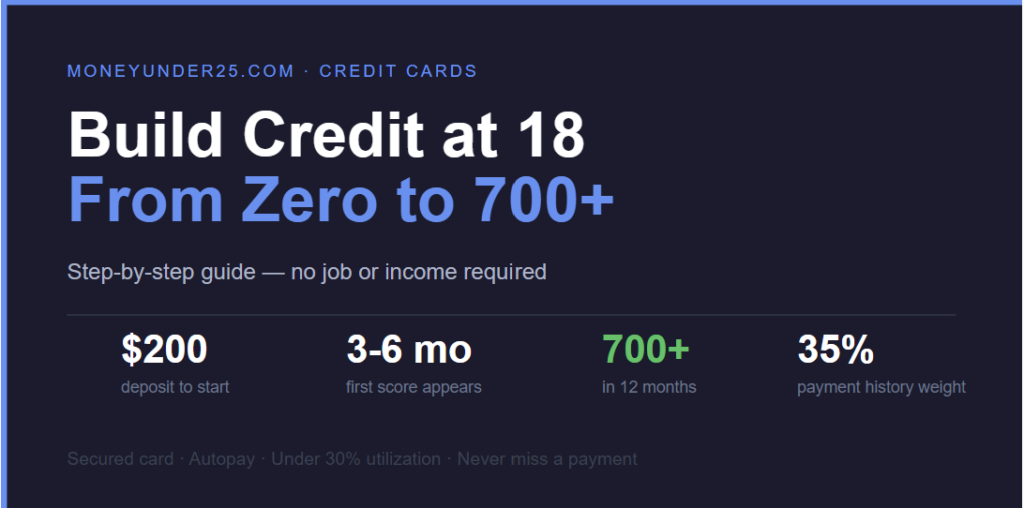
If you’re starting from scratch with no credit history, read our full guide on how to build credit at 18 — it covers every step in detail.
Option 2 — Apply With a Co-Signer
A co-signer with strong credit (720+) can get you approved and qualify for better terms even if your score is too low on its own. The co-signer’s credit is on the line if you miss payments, so this requires real trust from the person co-signing.
Important: if you miss a payment, it damages both your credit AND the co-signer’s credit. Only go this route if you are 100% confident in your ability to make every payment on time.
Option 3 — Put More Money Down
A larger upfront payment (called a capitalized cost reduction) reduces the dealer’s risk and can sometimes get a borderline application approved. This is more common with buying than leasing, but some lessors will approve a 620–650 score with $2,000–$3,000 down where they wouldn’t approve with nothing down.
Downside: if the car is totaled in an accident, you lose the down payment and gap insurance won’t cover it. Most lease experts actually advise against putting money down on a lease for this reason.
Option 4 — Buy Instead of Lease
If your score is below 620 and you need a car now, buying a used car — either with cash or a secured auto loan — is often smarter than trying to force a lease. Used car loans are available for lower scores, and once you’ve made 12–24 months of on-time payments, your credit will be strong enough to lease next time.
Building that savings cushion first also helps — see our guide on how to save $1,000 in 3 months for a practical starting point.
What to Do Before You Visit a Dealership
Going in prepared is the difference between a smooth process and a stressful one. Here’s the exact checklist:
- Check your credit score for free: Use Credit Karma, your bank’s app, or Discover’s free credit scorecard. Know your number before anyone else does.
- Pull your full credit report: AnnualCreditReport.com gives you free reports from all three bureaus. Look for any errors or collections you weren’t aware of.
- Get pre-qualified if possible: Capital One Auto Navigator and some credit unions offer soft-pull pre-qualification for leases and auto loans. This takes 5 minutes and gives you real numbers.
- Know your target tier: Based on your score, check the tier table above. If you’re borderline between tiers, ask the dealer upfront what their minimum score is before they pull your credit.
- Shop within a 14-day window: If you’re visiting multiple dealers, do all your applications within two weeks. This protects your score from multiple hard inquiries.
- Understand the money factor: Ask the dealer for the money factor on any lease offer. Multiply by 2,400 to convert to an equivalent APR. If they won’t tell you, walk out — it’s public information.
Lease vs. Buy: Which Makes More Sense at Your Credit Score?

This question comes up constantly, so here’s a straightforward breakdown:
| Your Score | Leasing makes sense if… | Buying makes more sense if… |
| 720+ | You want a new car every 3 years, low monthly payments | You drive a lot, want to build equity |
| 660–719 | You qualify but terms aren’t great — shop around | Buying a used car might be cheaper overall |
| 580–659 | Leasing is difficult — most lessors will decline | Used car purchase, build credit for 12 months, then reconsider leasing |
| Below 580 | Not recommended at this score | Cash purchase of older used car, or credit-builder loan first |
FAQs
Can I lease a car with a 600 credit score?
It’s difficult but not impossible. Some dealerships and third-party lenders will approve a 600 score, but expect significantly higher monthly payments and possibly a larger security deposit. Manufacturer captive lenders (Toyota Financial, Honda Financial, etc.) typically require 620–640 as a minimum. Your best move at 600 is either shopping at dealers that use third-party banks, applying with a co-signer, or spending 6 months building your score before leasing.
Does getting denied for a lease hurt my credit score?
The hard inquiry from the application will drop your score by 5–10 points, regardless of whether you’re approved or denied. The denial itself doesn’t show up on your report — only the inquiry does. This is why checking your score and getting pre-qualified before visiting the dealer matters. If you know your score is too low, don’t let them pull your credit until you’re ready.
What credit score do you need for a lease with no money down?
Most no-money-down leases require a 700+ credit score, sometimes 720+. Dealers offering zero down are taking on more risk, so they offset it by requiring stronger credit. If your score is 660–699, you’ll likely need at least $500–$1,500 upfront to secure the same deal that a 720+ score gets with nothing down.
How is leasing different from financing a car purchase in terms of credit?
Leasing and financing use similar credit score tiers, but leasing is generally slightly harder to qualify for because there’s no asset transfer — you’re renting the car, and the lessor takes on the residual value risk. Car loans through a bank or credit union often have more flexibility at the 580–650 range. If you’re under 650 and need a car now, a used car loan is usually the easier path. Once you have 12 months of on-time auto payments, your score will likely be high enough to lease. Here’s a guide on how to build credit at 18 if you’re starting from scratch.
What is a good money factor for a lease?
Money factor is the lease equivalent of an interest rate. A good money factor in 2026 is generally below .00100, which converts to roughly 2.4% APR. Anything above .00200 (4.8% APR) starts getting expensive. Always ask the dealer for the money factor before signing. You can check current manufacturer lease deals on Edmunds or Reddit’s r/askcarsales to see what the standard money factor is for the car you’re interested in — dealers won’t volunteer this information unless you ask.
The Bottom Line
To lease a car with the best terms in 2026, you want a 720+ credit score. With 660–719 you’ll still get approved but pay a bit more. Below 620 and most captive lenders will decline you — at that point, building credit first or buying a used car is the smarter move.
The good news is that credit scores are not fixed. If you’re 18–22 and your score isn’t where it needs to be, six months of consistent effort — on-time payments, low utilization, no new applications — can realistically move you from 620 to 700+. The car you want will still be there.
Start by checking your score for free, then read our guide to the best first credit cards to start building the credit history you need.
Sources
1. Experian — credit scores needed for leasing a car
2. myFICO — auto loan credit tiers and score impact
3. Consumer Financial Protection Bureau — auto loan resources
Pingback: Best Credit Cards for No Credit History in 2026 | MoneyUnder25
Pingback: Can You Insure a Car Not in Your Name? | MoneyUnder25
Pingback: How to Build Credit at 18 (Even With No Income) | MoneyUnder25
Pingback: What Is Credit Utilization? How It Affects Your Credit Score
Pingback: Credit Score Ranges Explained: What Your Score Actually Means