
Did you know that 61% of people your age are losing sleep over money right now? It’s not just you. Between the rising cost of living and the “broke” stigma that follows you on social media, it often feels like the game is rigged. Achieving financial wellness for young adults shouldn’t feel like learning a foreign language while your bank account is on fire. You’re probably tired of hearing about “avocado toast” from people who bought houses for the price of a used car. You want to feel secure without living like a hermit (and yes, that is actually possible).
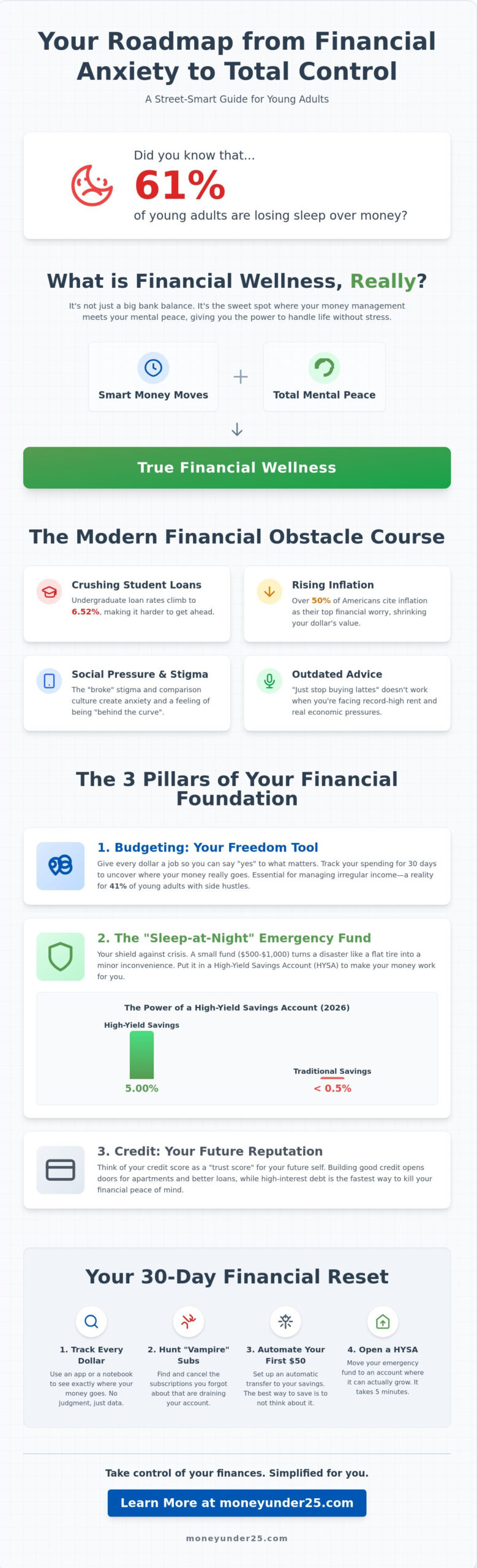
This guide is your street-smart roadmap to moving from financial anxiety to total control. We are moving past the “broke” label and into a world where you actually have a plan for your cash. You’ll learn how to navigate 2026’s 6.52% student loan rates and make 5.00% high-yield savings work for your future. We are going to build a “sleep-at-night” emergency fund and a budget that doesn’t feel like a prison. By the end of this, you will have the confidence to handle the next surprise bill without breaking a sweat. Let’s get to work.
Key Takeaways
- Define financial wellness for young adults as the intersection of smart money moves and total mental peace.
- Learn to view budgeting and credit not as chores, but as “freedom tools” that give you control over your future.
- Discover how to pivot your strategy when inflation and debt make progress feel impossible.
- Master a 30-day reset that hunts down “vampire” subscriptions and puts your cash back where it belongs.
- Build a “sleep-at-night” emergency fund using straightforward finance management systems built for the under-25 crowd.
What Does Financial Wellness Actually Look Like? (Hint: It’s Not Just a Big Bank Balance)
Think about the last time you opened your banking app. Did you do it with a sense of calm, or did you squint one eye, praying the balance wasn’t lower than you feared? Most traditional institutions treat money like a cold math problem. If your math is right, you’re fine. But life isn’t a spreadsheet; it’s a series of choices influenced by stress, social pressure, and survival. True What Does Financial Wellness Actually Look Like? is the sweet spot where your money management meets your mental peace. It’s about how you feel when the bill arrives, not just the number of zeros in your account.
There’s a massive difference between financial literacy and financial wellness. Literacy is simply knowing facts, like understanding that top high-yield savings accounts in 2026 offer up to 5.00% APY. Wellness is actually moving your money into one of those accounts because you want your future self to be secure. In a year where more than half of Americans cite inflation as their biggest worry, just “knowing” isn’t enough. Financial wellness for young adults requires taking healthy, repeatable actions that protect your headspace from the constant noise of the economy.
How do you know if your wellness needs a tune-up? Look for the anxiety signals. If you find yourself lying to friends about why you can’t go out, or if you feel a “behind the curve” panic every time you see a peer’s vacation post, your system is leaking. These aren’t just personality quirks; they’re signs that your capital oversight needs a more intentional strategy.
The Shift from Anxiety to Autonomy
Autonomy means checking your balance shouldn’t feel like a jump-scare. It’s the power to say “no” to plans because they don’t fit your budget, and actually feeling okay with that choice. When you move from reactive spending to proactive finance management, you stop being a victim of your own impulses. You start directing your cash toward things that actually matter to you, rather than just paying for past mistakes.
Why Traditional “Advice” Fails Young Adults
Most “gurus” love the avocado toast myth. They claim you’re broke because of lattes, ignoring the reality of 6.52% undergraduate loan rates and skyrocketing rents. We know that for someone under 25, a $1,000 emergency fund is a total psychological game-changer. It’s the difference between a flat tire being a minor inconvenience or a total life disaster. Money Under 25 acts as your street-smart mentor, helping you build these foundations without the corporate fluff or judgment that usually comes with bank-led advice.
The Three Core Pillars of Your Financial Foundation (Without the Boring Lectures)
Most people hear the word “budgeting” and think of a prison sentence. Let’s flip that perspective immediately. These aren’t chores; they’re freedom tools. They are the systems that allow you to say yes to a weekend trip without having to do frantic math at the gas station. Building financial wellness for young adults isn’t about being perfect from day one. It’s about showing up consistently. Even if you’re only working with a few extra dollars a week, starting small is infinitely better than waiting for a “perfect” salary that might be years away.
Budgeting That Doesn’t Suck (Yes, It Exists)
The goal here is to give every dollar a job. If you don’t tell your money where to go, it will simply disappear into the void of late-night takeout and “vampire” subscriptions. Try tracking every single cent you spend for just 30 days. It is the ultimate reality check. Since 41% of young adults now rely on side hustles, according to 2026 data, managing irregular income is a vital skill. A solid plan ensures you don’t overspend during the “up” months and end up stressed when the gig work slows down.
The “Sleep-at-Night” Fund
That first $500 in savings is your shield. It stops a flat tire or a broken phone screen from becoming a credit card crisis. Put this cash in a high-yield savings account where it can actually grow; some top accounts are offering up to 5.00% APY right now. The secret to success is automation. If you have to remember to save, you probably won’t do it. Set up a recurring transfer for the day your paycheck hits. You can explore more ways to simplify your finance management to make this process feel effortless and automatic.
Credit: The Double-Edged Sword
High-interest debt is the fastest way to kill your peace of mind. Think of your FICO score as a “reputation score” for your future self. It tells landlords and lenders if you’re reliable. You don’t need to carry a balance or pay interest to build a great score. The “young adult trap” is falling into the minimum payment cycle, where you end up paying double for a pair of sneakers over three years. Pay your balance in full every month to keep your reputation, and your wellness, intact.
Why Financial Wellness Feels Impossible Right Now (And How to Pivot)
It’s easy for people to tell you to “just save more,” but they aren’t the ones facing 2026’s economic reality. With 76% of young adults citing the rising cost of living as their primary stressor, it’s no wonder financial wellness for young adults feels like a luxury you can’t afford. You might think you don’t make enough money to even bother with a plan. This is the biggest lie in the book. If you can’t manage $100 today, you’ll struggle to manage $10,000 tomorrow. At Money Under 25, our stance is clear: you simply cannot out-earn a lack of a system.
Social media makes this mountain feel even steeper. It fuels “Comparisonitis,” a toxic loop where you compare your actual bank account to someone else’s curated highlight reel. You see influencers in rented jets and think you’re failing because you’re still living with roommates. This often leads to “revenge spending,” where you buy things you don’t need just to prove you aren’t falling behind. It is a game you will never win unless you decide to change the rules and focus on your own progress.
Battling Lifestyle Creep and Peer Pressure
Every time you get a small raise or a side hustle bonus, you will feel the urge to upgrade your life. Lifestyle creep is the silent killer of wealth. Suddenly, yesterday’s “luxury” becomes today’s “necessity,” and you’re right back to living paycheck to paycheck regardless of your income. You have to learn to set boundaries with friends who have different spending habits. It’s perfectly okay to say, “That’s not in my budget right now.” Real friends won’t judge you for it. In fact, they’ll probably be relieved they don’t have to spend the money either.
Overcoming the “I’ll Start Later” Trap
The “I’ll start when I have a real job” excuse is a massive wealth-killer. Starting at 22 is ten times easier than starting at 32 because time is your greatest asset. You don’t need a six-figure salary to begin mastering your capital. Even if you’re a student or working part-time, the habits you build now are the foundation for everything that comes later. The math is brutal; waiting a decade to start means you often have to save triple the amount to reach the same financial goals. Don’t wait for a “perfect” moment that will never come. Start with the cash you have in your pocket today.
A 30-Day Action Plan to Reset Your Financial Health
Stop thinking about money as a lifelong mystery you’ll solve “someday.” Instead, think of it as a 30-day fitness challenge for your wallet. If you can commit to one small action every day for a month, you’ll break the cycle of anxiety that keeps 42% of Gen Z living paycheck to paycheck. This isn’t about being restrictive forever. It’s about building a foundation of financial wellness for young adults that actually sticks. By the end of this month, you won’t just have more cash; you’ll have a system that works while you sleep.
Week 1: Face the Numbers (The Audit)
You can’t fix what you don’t see. For the first ten days, your only job is to be a financial investigator. Download a spending tracker or use a simple spreadsheet to categorize every cent spent in the last 30 days. Group them into “Need” (rent, basic groceries) versus “Want” (that third streaming service, the 4 PM energy drink). You will likely find a “money leak” that surprises you. Maybe it’s the $80 a month going to a gym you haven’t visited since January. Identifying these leaks is the only way to stop the bleed.
Week 2: Plug the Leaks (The Trim)
Now that you’ve found the leaks, it’s time to plug them. Start a “Subscription Purge” and cancel everything you don’t use daily. Call your phone or internet provider and ask for a lower rate; saving just $20 a month is an easy win that stays in your pocket forever. To really reset your brain, try a “No-Spend” weekend. It forces you to find free ways to have fun and breaks the habit of “boredom shopping” that kills so many budgets. It’s a fast way to prove you’re in control, not your impulses.
Week 3 & 4: Build the Machine (The Automation)
The final phase is about making your progress permanent. You shouldn’t have to rely on willpower to save money. Set up a recurring transfer to your high-yield savings account for the day your paycheck hits. Configure auto-pay for all your fixed bills to avoid those soul-crushing late fees. This is where your new finance management system becomes a machine that runs on autopilot. Once the tracks are laid, you can stop stressing about the “how” and start enjoying the “what” of your financial future.
How Money Under 25 Simplifies Your Finance Management
You’ve done the hard work of auditing your spending and plugging the leaks. But let’s be real; staying consistent is the hardest part when the rest of the world is trying to sell you a lifestyle you can’t afford yet. Most financial advice is built for people who already have a house and a 401(k). It doesn’t account for the reality of gig work, rising rents, or the pressure to keep up with your friends. That is where we come in. We focus exclusively on financial wellness for young adults because we know your situation is unique. Our approach isn’t about following a dusty textbook; it’s about giving you the street-smart strategies you need to thrive in 2026.
We provide the tools you actually need without the corporate fluff that usually makes banking feel like a chore. By connecting your 30-day reset to long-term financial independence, we help you move past the “broke” stigma for good. You are building a system that allows you to live your life today while protecting the version of you that exists ten years from now. It is about capital oversight that fits your actual life, not an idealized version of it.
Structured Tools for Modern Capital Oversight
Our strategies are designed to be adaptable. We know your income might be a mix of a part-time job, a side hustle, and maybe a little help from home. That is why our resources focus on practical finance management for young adults that works even if you’re starting with a small balance. We don’t offer complex credit repair services or personal financial planning; instead, we teach you how to manage yourself. You’ll learn how to navigate the 2026 economy where Gen Z literacy scores have hit a decade low of 38%. We fill those gaps so you can make decisions with total confidence. Our guides are built for real-life scenarios, like deciding if a BNPL purchase is worth the stress or how to maximize a 5.00% APY savings account.
Join a Community That Gets It
Money is often a silent struggle, but it doesn’t have to be. When you access our resources, you’re joining a community of people who are tired of the “avocado toast” lectures and ready for real solutions. We provide the education that high school skipped, focusing on the specific hurdles of being young and under-resourced. You don’t have to figure this out by trial and error anymore. Stop feeling alone in your financial struggle and start using a system designed for your generation. It’s time to take the wheel and drive toward the life you actually want.
Start your finance management journey with Money Under 25 today!
Take Control of Your Cash and Your Peace of Mind
You have the roadmap now. You’ve seen that financial wellness for young adults isn’t about having a massive inheritance or waiting for a six-figure salary to magically appear. It is about those small, daily wins like auditing your “vampire” subscriptions and letting automation do the heavy lifting for your savings. You’ve learned that your peace of mind is worth more than any impulse purchase, and that starting today gives you a massive advantage over everyone who is waiting for “someday.”
We are here to help you keep that momentum going with specialized finance management designed for your life. You don’t need corporate fluff or complex jargon; you need practical tools for daily capital oversight that actually work when things get messy. Our no-fluff, peer-to-peer educational resources are built to fill the gaps and keep you moving forward regardless of your starting point. It is time to stop reacting to your bank balance and start directing it.
Ready to level up? Master your money with Money Under 25. You have the power to change your financial story starting right now. The game isn’t rigged when you know the rules, and we are in your corner every step of the way. You’ve got this.
Frequently Asked Questions
What is the first step to financial wellness if I have $0 in savings?
The first step is to track every single cent you spend for at least two weeks. You can’t fix a problem you haven’t identified yet. Once you see where your money is leaking, you can find just $10 or $20 to set aside from your next check. It’s about breaking the zero-balance cycle and proving to yourself that you’re the one in control of your cash.
How much of my paycheck should a young adult save for an emergency fund?
Aim to set aside at least 10% of every paycheck until you have a $500 starter fund. This small buffer prevents most minor “emergencies” from turning into a credit card crisis. Once you hit that first milestone, keep the momentum going by moving that cash into a high-yield savings account. In 2026, many of these accounts offer up to 5.00% APY, which helps your money grow while you sleep.
Is financial wellness possible while paying off student loans?
Yes, financial wellness for young adults is absolutely possible even when you’re carrying debt. It’s about finding a sustainable balance where you meet your minimum payments while still building your own safety net. You don’t have to wait until your 6.52% undergraduate loans are completely gone to start feeling secure. Wellness is the peace of mind you get from having a plan, not just being debt-free.
What are the best budgeting methods for beginners with irregular income?
The “Zero-Based Budget” or “Give Every Dollar a Job” method is the gold standard for gig workers. Instead of guessing what you might make next month, you only budget the money you currently have in your bank account. This prevents you from overspending during lean months. It is the most realistic way to handle capital oversight when your income fluctuates from week to week.
How does financial wellness affect my mental health and stress levels?
Financial wellness acts as a massive stress-reliever by removing the “fear of the unknown” from your daily life. When you know exactly what you have and where it’s going, the physical symptoms of anxiety often start to fade. You stop living in a state of fight-or-flight every time you swipe your card. It turns money from a source of constant panic into a tool for your own autonomy.
Do I need a high-paying job to achieve financial wellness before 25?
No, you don’t need a six-figure salary to achieve financial wellness for young adults. Wellness is about the systems you use to manage whatever income you have right now. Someone making $35,000 with a solid budget and a small emergency fund is often more “well” than someone making $100,000 who lives paycheck to paycheck. It is about your habits, not just your tax bracket.
What is the difference between financial literacy and financial wellness?
Literacy is simply knowing the facts, like how interest rates work, while wellness is the actual application of those facts to your life. You can read every finance book on the shelf and still be stressed if you don’t take action. Wellness is the emotional and physical state of being in total control of your money. It’s the difference between “knowing” what to do and actually “doing” it.
Can I still have a social life while focusing on financial wellness?
You can definitely have a social life, but it might require a bit more intentionality and creativity. Focus on “low-cost, high-value” hangouts like park picnics or game nights instead of expensive dinners every weekend. Wellness isn’t about saying “no” to everything you love. It’s about saying “yes” to the things that actually matter to you while cutting out the mindless spending that doesn’t add real value.