You’re standing in the grocery aisle, staring at a $12 pack of chicken and wondering if it will break your budget for the next ten days. It’s a stressful way to live, especially when news headlines talk about a $1.66 trillion national student debt mountain. Mastering financial literacy for students isn’t about becoming a math genius or living on ramen forever. It’s about building a system that works while you’re still in class.
I know how it feels to have your stomach drop when you check your bank balance. You want to have fun and pay rent without the constant “can I afford this?” anxiety. This guide gives you the tools to move from financial uncertainty to total confidence before you even walk across the graduation stage. Success is closer than you think if you follow a clear path.
We’ll break down a simple system to track your spending and show you how to grow your capital with high-yield accounts hitting 4.15% APY. You’ll learn how to handle the 2026 FAFSA deadlines and manage those 6.52% undergraduate loan rates without losing your mind. Let’s get your money under control.
Key Takeaways
- Learn how to manage your capital effectively so you can stop guessing if you have enough for rent or groceries.
- Discover why financial literacy for students is more about building a reliable system than being a math expert.
- Compare the Zero-Based and 50/30/20 budgeting methods to find the one that fits your specific daily schedule.
- Implement five-minute micro-habits that keep your finances organized without taking over your weekend.
- Follow a practical 30-day roadmap to audit your current habits and build a budget that allows for both savings and fun.
Why Financial Literacy for Students is Your Ultimate Secret Weapon
Real financial literacy for students isn’t about memorizing a dictionary of banking terms. It’s the practical ability to manage your capital effectively every single day. While many sources offer a comprehensive overview of financial literacy, we focus on the reality of your bank account. It’s the difference between guessing if you can afford a coffee and knowing exactly how much is left after rent. When you treat your money as a tool rather than a source of stress, you gain a level of freedom most adults don’t even have.
Why does this matter? Because of the “Confidence Gap.” When you don’t understand how money moves, you make expensive mistakes by default. You might ignore a mounting credit card balance or miss a FAFSA deadline because the jargon feels too heavy. This lack of knowledge leads to a constant, low-level anxiety that follows you into every store. We’re here to close that gap. We want to move you from the “I hope this card works” phase of life to a place where you’re in total control of your financial future.
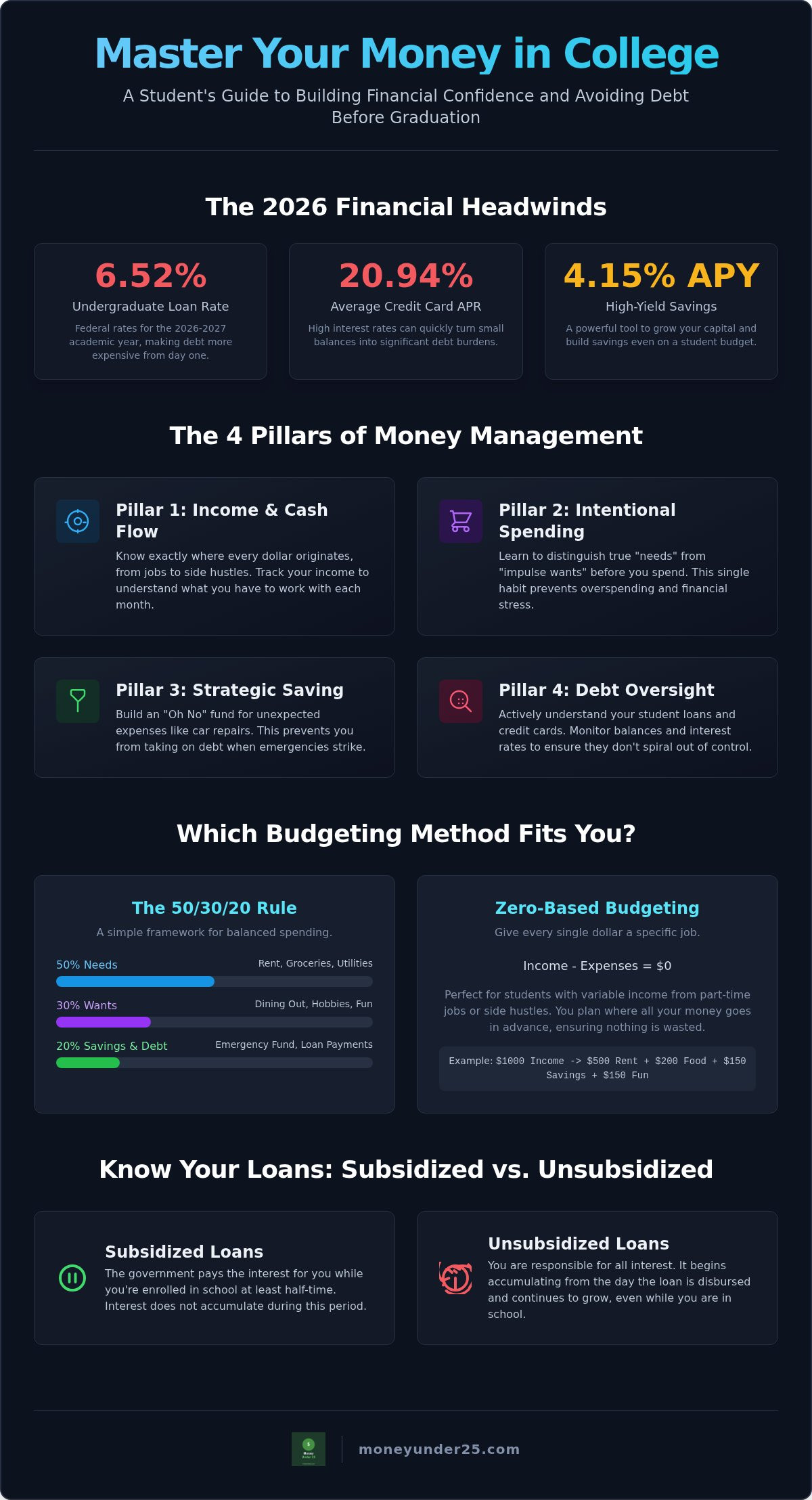
Managing money in 2026 is objectively harder than it was for previous generations. Undergraduate loan rates for the 2026-2027 year are sitting at 6.52%, and average credit card interest has climbed to 20.94%. You aren’t “bad with money” just because you’re struggling; you’re operating in a high-pressure environment. Building these skills now is a survival strategy that turns into a massive advantage the moment you graduate. You’ll be ready to grow your capital while others are still trying to figure out where their paycheck went.
The Myth of the ‘Broke Student’
Society tells you that being a student means being poor, stressed, and surviving on instant noodles. This is a dangerous trope. Mastering financial literacy for students means rejecting the idea that you have to be broke to be a “real” student. You don’t need a six-figure salary to start practicing capital oversight. If you can manage a $50 weekly grocery budget today, you’re building the exact muscles needed to manage a mortgage or a business later. Small, intentional habits now prevent massive debt mountains from forming after you finish your degree.
Why 2026 Demands New Skills
The world has moved beyond physical wallets and paper checks. Digital payments and “Buy Now, Pay Later” schemes make spending feel invisible, which makes it easier to lose track of your cash flow. In 2026, traditional banking advice often fails because it doesn’t account for the speed of digital transactions. You need a modern approach to capital oversight. This means using high-yield savings accounts that offer up to 4.15% APY and seeing your money as a resource to be directed, not just a balance that disappears. Learning to track “invisible” spending is a core life skill that keeps you ahead of the curve.
The 4 Pillars of Student Money Management
Building a solid foundation for your future doesn’t require a finance degree. It requires focus on four specific areas that dictate how your money behaves. Mastering financial literacy for students starts with these pillars. Get these right, and your financial life becomes much easier to manage.
- Pillar 1: Income & Cash Flow. This is about knowing exactly where every cent originates, whether it’s a part-time job, a side hustle, or a family allowance.
- Pillar 2: Intentional Spending. You must learn to separate your true “needs” from “impulse wants” before you swipe your card.
- Pillar 3: Strategic Saving. This means building an “Oh No” fund to cover car repairs or medical bills so you don’t have to borrow money in a panic.
- Pillar 4: Debt Oversight. You need to understand your student loans and keep a close eye on interest rates so they don’t spiral out of control.
Mastering Your Cash Flow
Cash flow is like a water tank where your income is the pipe filling it up and your expenses are the tap letting it out. If the tap stays open wider than the pipe, you’ll eventually run dry. When your income varies because of side hustles or shifting work hours, tracking becomes even more critical. You can’t just hope there’s enough left at the end of the month. You have to assign a specific job to every dollar the moment it hits your account. This proactive approach to finance management ensures you never wonder where your paycheck went.
Navigating Student Loans and Debt
Federal student loan rates for the 2026-2027 academic year are 6.52% for undergraduates. It’s vital to know the difference between subsidized and unsubsidized loans. With subsidized loans, the government pays your interest while you’re in school. With unsubsidized loans, that interest starts growing the day you take the money. Don’t wait until graduation to look at your balance. Check it monthly to stay grounded in reality.
Avoid the trap of high-interest credit cards, which currently average 20.94% interest. One “emergency” pizza on a credit card can end up costing you double if you only pay the minimum balance. Building your financial literacy for students means staying sharp and protecting your future capital from these expensive traps. Keep your debt oversight consistent to ensure you graduate with a plan, not just a bill.
Which Budgeting Method Fits Your Student Lifestyle?
There isn’t a single “right” way to handle your cash. Your life as a student is chaotic, and your budget should reflect that reality. Whether you’re managing a small allowance or a steady paycheck from a side hustle, the goal is to find a system that feels like a tool, not a chore. Strengthening financial literacy for students means testing different methods until one clicks with your specific personality and schedule.
If you love having total control, the Zero-Based Budget is your gold standard. This method ensures that every single dollar you earn is assigned a specific task. By the time you’re done, your income minus your expenses should equal zero. For those who prefer a “set it and forget it” vibe, the 50/30/20 Rule is a great alternative. You put 50% toward needs like rent, 30% toward wants, and 20% toward savings or debt. It’s a simple way to maintain balance without tracking every pack of gum.
Visual learners often thrive with a digital envelope system. You set spending limits for different categories, like groceries or dining out, and stop once the “envelope” is empty. Regardless of the method you choose, you must include a “Fun Fund.” If your budget is too restrictive, you’ll eventually abandon it. Allowing yourself space for a movie or a night out makes your financial plan sustainable for the long haul. It’s about balance, not deprivation.
The Zero-Based Approach for Beginners
Don’t wait until you’re “rich” to start. You can build a zero-based budget even if you only have $100 in your account right now. First, list your total income. Next, list your fixed expenses, such as your phone bill or a streaming subscription. Finally, distribute the remaining cash into categories like food or transport until there’s nothing left unassigned. You can learn more about why Zero-Based Budgeting: Why Every Dollar Needs a Job is the ultimate way to gain clarity over your capital.
Managing Money with Roommates
Living with others is a great way to save, but it can lead to massive headaches if you don’t have a plan. Shared utilities and groceries are the most common friction points. To avoid drama, use digital tools to split bills instantly the moment they arrive. Transparency is key to keeping the peace and ensuring everyone stays on track. Check out our guide on Managing Money with Roommates Without the Drama for practical tips on keeping your living situation stress-free. True financial literacy for students involves mastering these social money dynamics just as much as the math.
Building Your Digital Toolkit: Essential Habits for 2026
The best financial tool isn’t the one with the most features; it’s the one you actually use. Some students swear by manual spreadsheets because typing in every dollar forces a level of awareness that apps can’t replicate. Others prefer the speed of automation. Both paths work. Improving financial literacy for students involves finding the specific friction point that stops you from tracking your money and removing it. If apps feel like a chore, try a simple note on your phone. If spreadsheets feel like homework, let technology do the heavy lifting.
Success comes down to micro-habits. Set a recurring alarm for a five-minute Sunday night financial check-in. Use this time to scan your transactions from the week and ensure you’re still within your “Fun Fund” limits. This tiny habit prevents the end-of-month panic when you realize your balance is lower than expected. It keeps you in the driver’s seat of your own capital oversight without taking over your entire weekend.
Automation is your second best friend. Set your banking app to move a small amount, even just $5, into your savings account the moment your paycheck or allowance hits. Moving money out of sight automatically reduces the temptation to spend it. To curb impulse buys, implement the “24-Hour Rule” for online shopping. If you want something that isn’t a necessity, leave it in the cart for a full day. Most of the time, the urge to buy will fade, saving your budget from unnecessary leaks.
Choosing the Right Budgeting App
In 2026, you shouldn’t have to pay for a budgeting tool. Look for apps that offer robust free versions, high-level security, and a simple interface. Before you try to master complex forecasting, focus on one skill: expense tracking. Knowing exactly where your money goes is the foundation of all financial success. You can start mastering this today with our guide on Expense Tracking for Students: Keep Your Cash Flowing. Once you see the patterns in your spending, creating a full budget becomes much easier.
Digital Security and Privacy
Protecting your data is a critical part of financial literacy for students. AI-driven scams are becoming more sophisticated, often mimicking bank alerts or school payment portals. Never click on a link in an unexpected text or email. Always use two-factor authentication (2FA) for every financial account you own. Additionally, watch out for “subscription creep.” Check your recurring payments monthly to ensure you aren’t still paying for a gym you don’t visit or a streaming service you don’t watch. If you want to take total control of your money, you can start using our tools for finance management to audit your accounts for these hidden costs.
Your 30-Day Roadmap to Financial Confidence
Confidence doesn’t happen overnight. It’s built through a series of small, intentional wins. If you’ve felt overwhelmed by the concepts we’ve covered, this roadmap is designed to simplify your path. Improving financial literacy for students is a marathon, not a sprint. Follow these steps to move from uncertainty to total control of your capital in just one month.
- Week 1: The Audit. Change nothing about your spending. Simply record every single cent that leaves your account. Whether it’s a $2 vending machine snack or a $60 grocery run, write it down. This builds the awareness needed for real change.
- Week 2: The Setup. Use the data from your audit to choose a budgeting method. If you want total control, try the Zero-Based approach. If you’re busy, go with the 50/30/20 rule. Create your first budget based on your actual income and fixed costs.
- Week 3: The Adjustment. Look for “leakage.” These are the small, recurring costs or impulse buys that don’t add value to your life. Redirect that capital toward your “Oh No” fund or your student loan balance.
- Week 4: The Automation. Make your success permanent. Set up recurring transfers to your savings and enable balance alerts on your banking app. Technology should do the heavy lifting so you can focus on your studies.
Finding Your ‘Why’
A budget without a purpose is just a list of restrictions. To make your habits stick, you need to connect your tracking to a goal that actually excites you. Maybe you want to save for a study abroad trip, buy your first car, or graduate without credit card debt. Focus on financial stability rather than “being rich.” Stability means you don’t panic when a bill arrives. A SMART goal for a 20-year-old might be: “I will save $600 for a study abroad deposit by December 2026 by automating a $50 monthly transfer and cutting two unnecessary subscriptions.”
Next Steps with Money Under 25
You don’t need a finance degree to be exceptional with money. You just need the right tools and a bit of consistency. We’ve designed our resources to help you maintain your momentum long after you finish this guide. Real financial literacy for students is about taking that first step, even if it feels small. Don’t let the fear of doing it perfectly stop you from doing it at all. Your future self will thank you for the work you do today. Start your first tracking sheet today and take ownership of your financial journey.
Build Your Financial Future Starting Today
You’ve now seen that financial literacy for students isn’t about complex math or living like a monk. It’s about building a system that manages your capital for you. By mastering the four pillars and setting up a simple budget, you’ve already done more for your future than most adults. Remember that small habits like Sunday night check-ins and automated transfers are what turn a small paycheck into long-term stability.
The chaos of student life doesn’t have to mean constant money stress. Whether you’re managing variable side hustle income or navigating those 6.52% interest rates, you have the tools to stay in control. You don’t need a finance degree to protect your capital and enjoy your college years at the same time. Success is attainable if you just follow the path.
Take control of your capital today with Money Under 25. We provide practical, jargon-free guidance specialized for young adults who want real-world capital oversight. You’ve got the roadmap; now it’s time to drive. You’re ready to move from uncertainty to quiet confidence.
Frequently Asked Questions
What is the best way for a student to start learning about money?
Start by tracking every cent for one week. Awareness is the foundation of all success. Don’t worry about complex plans yet. Use a simple note on your phone or a small notebook to record your spending. This provides the data you need to make decisions later. Once you see where your money actually goes, the next steps feel much less intimidating. It’s the most practical entry point into financial literacy for students.
How much should a college student save each month?
Aim to save at least 10% to 20% of whatever income you have, even if it’s just $10 from a $100 paycheck. The specific dollar amount matters less than the habit of moving money into savings immediately. If you can’t manage 10%, start with $5. High-yield savings accounts in 2026 offer rates up to 4.15% APY, which helps your small contributions grow faster over time while you’re still in school.
Can I build credit as a student without a full-time job?
You can build credit by becoming an authorized user on a parent’s card or by getting a secured credit card. A secured card requires a small deposit that acts as your limit, making it a training wheels version of a credit card. Pay your balance in full every month to avoid the 20.94% average interest rates. Consistent, on-time payments are the biggest factor in your score and your future financial health.
What are the most common financial mistakes students make?
The biggest mistake is ignoring your bank balance because you’re afraid of what you’ll see. Other traps include relying on Buy Now, Pay Later services for non-essentials or missing FAFSA deadlines. In 2026, many students also fall victim to subscription creep, where small monthly fees for apps quietly drain their accounts. Awareness and regular check-ins prevent these small leaks from becoming major problems that follow you after graduation.
How do I handle my finances if my income is different every month?
Use a baseline budget based on your lowest expected monthly income. If you earn more from side hustles one month, treat that extra cash as a bonus for your savings or debt payments. This prevents you from overextending yourself during high-earning months and then struggling when work slows down. It’s about creating a safety net that keeps your finances predictable even when your paycheck fluctuates throughout the semester.
Is it better to pay off student loans or save for an emergency fund first?
Prioritize building a small emergency fund of $500 to $1,000 before aggressively paying down loans. Having this cash on hand prevents you from using high-interest credit cards when a car repair or medical bill pops up. Once your fund is set, focus on your loans, especially unsubsidized ones that gather interest at 6.52% while you’re still in school. This strategy protects you from debt while you’re working toward long-term stability.
What are the best free budgeting apps for students in 2026?
Look for apps that emphasize manual tracking or simple bank syncing without monthly fees. In 2026, many students prefer tools that offer a digital envelope system or a zero-based interface. The best app is simply the one you find easiest to open every day. If an app feels too complicated, a basic spreadsheet or a notes app is a perfectly valid way to master financial literacy for students and gain control.
How can I afford to have a social life while budgeting?
Create a dedicated Fun Fund in your budget so you can say yes to plans without guilt. Budgeting isn’t about saying no to everything; it’s about saying yes to what matters most. If your friends want to go out, look for student discounts or suggest low-cost alternatives like a potluck or a movie night. Being honest about your budget with friends often reveals they’re in the same boat and looking to save too.