Quick Answer
To start building credit at 18: open a secured credit card, use it for one small recurring charge each month, and pay the full balance before the due date.
Your first credit score (typically 630-670) appears within 3-6 months.
With consistent on-time payments and credit utilization below 30%, most 18-year-olds reach 700+ within 6-12 months.
You do not need a job or income to start — a secured card only requires a $200-300 deposit.
The single biggest mistake: missing even one payment. Set autopay immediately.
When you turn 18, you do not have a bad credit score. You have no credit score at all. That distinction matters — because no score is not a penalty, it is simply an empty file. Lenders have no information about you yet, and your job over the next 6-12 months is to give them that information.
The good news: building credit at 18 is one of the most straightforward financial moves you can make. The process involves fewer steps than most people expect, and the timeline is faster than most people assume. According to the Consumer Financial Protection Bureau, a credit score typically appears within 3-6 months of opening your first credit account and using it responsibly.
This guide covers every method that actually works, the exact timeline to expect, and the mistakes that set people back months or years. If you want to know how long the process takes before reading further, how long it takes to build credit breaks down the full timeline by starting score and goal.
What Is Your Credit Score When You Turn 18?
Short answer: You have no credit score — not a zero, not a bad score. Your file is empty.
Credit scoring models like FICO and VantageScore require at least one account open for 6 months and reported to a credit bureau before they can generate a score. When you turn 18, neither of those conditions exists.
This is actually good news. You are not starting from a penalty — you are starting from neutral. Every responsible decision you make from here adds to a completely clean record.
| Myth | Reality |
| You start with a 300 (the lowest score) | You start with NO score. 300 is the floor for people with bad history, not beginners. |
| Your parents’ credit affects yours | Their credit does not transfer to you. You start completely fresh — unless they add you as an authorized user. |
| You need a job to build credit | A secured card requires a deposit, not income. You can open one with savings from any source. |
| Building credit takes years | Your first score appears in 3-6 months. 700+ is achievable within 12 months with consistent behavior. |
| Checking your own score hurts it | Checking your own score is a “soft inquiry” — it has zero effect on your credit score. |
3 Methods That Actually Work at 18
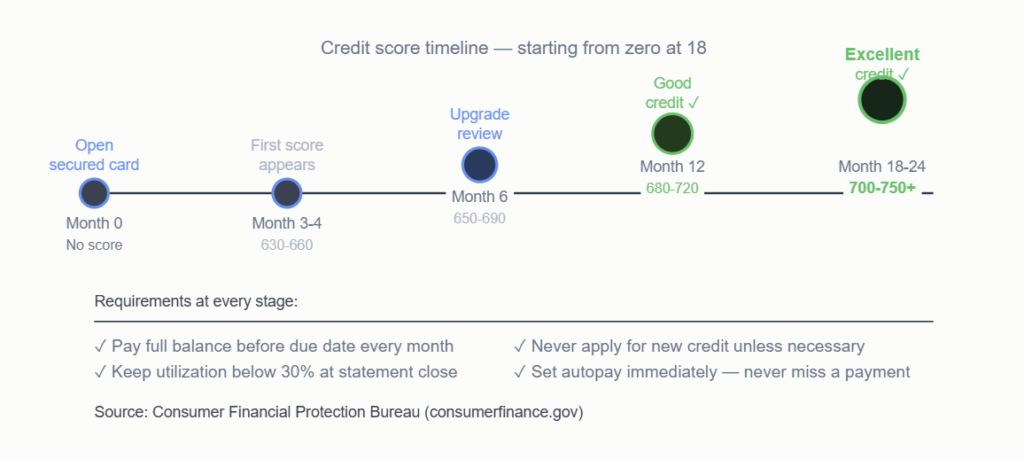
There are three proven ways to start building credit at 18. Most people use the first method, some combine two:
| Method | Speed | Cost | Best for |
| Secured credit card | 3-6 months | $200-500 deposit | Everyone — the standard first step. Full control. |
| Authorized user | Immediate | Free | People with a trusted parent or family member with good credit. |
| Credit builder loan | 6-12 months | $15-25/month | People who cannot get a secured card or want to build faster. |
Method 1: Secured Credit Card (Best Starting Point)
A secured credit card works like a regular credit card, but you deposit money upfront as collateral — typically $200-500. That deposit becomes your credit limit. According to the FDIC, secured cards are reported to the three major credit bureaus (Equifax, Experian, TransUnion) exactly like regular credit cards — meaning they build credit history just as effectively.
The best secured cards for beginners in 2026 have no annual fee, report to all three bureaus, and automatically upgrade to an unsecured card after 6-12 months of good behavior. Capital One Secured Mastercard and Discover it Secured are the two most commonly recommended options for first-time credit builders.
How to use it correctly: Charge one small recurring expense (a streaming subscription, a phone bill top-up) each month. Pay the FULL balance before the due date — not just the minimum. Keep your balance below 30% of your limit at statement closing date. That is the entire strategy.
Method 2: Become an Authorized User
If a parent or trusted family member has a credit card with a long, positive history — ask them to add you as an authorized user. Their entire account history shows up on your credit report immediately. This can give you a score in the 650-700 range within 30-60 days without you needing to apply for anything.
What to know: You do not need to use their card or even have the physical card. The history adds to your report just from the account association. If the primary account holder has any late payments or high utilization, those also appear on your report — so choose carefully.
Method 3: Credit Builder Loan
A credit builder loan works in reverse from a regular loan: the lender holds the money in a savings account while you make monthly payments. When the loan is paid off, you receive the money. Services like Self and Credit Strong offer these for $15-25/month and report every payment to all three credit bureaus.
This method works well alongside a secured card, but is usually not necessary on its own. If you can open a secured card, start there — credit builder loans are more useful for people who cannot get approved for any credit product.
Step-by-Step: How to Start Building Credit at 18
| Step | Action | Details |
| 1 | Save $200-300 | This is your deposit for the secured card. It earns interest while held and returns to you when you upgrade. |
| 2 | Apply for a secured card | Capital One Secured or Discover it Secured — both have no annual fee and report to all 3 bureaus. Apply online, takes 5 minutes. |
| 3 | Set up autopay immediately | Set autopay for the FULL balance on the due date — not the minimum. A single late payment can drop your new score by 60-100 points. |
| 4 | Charge one small thing monthly | Put one recurring charge on the card — Netflix, Spotify, a monthly subscription. Pay it off. Repeat every month. |
| 5 | Keep utilization below 30% | On a $300 limit, never carry more than $90 at statement closing. Pay before the statement closes if needed. |
| 6 | Check your score at month 3 | Your first score typically appears at month 3-6. Use a free service like Credit Karma or your bank’s credit score tool. |
| 7 | Wait for upgrade at month 6-12 | Most issuers review accounts at 6 months. If your payment history is clean, they upgrade to an unsecured card and return your deposit. |
The Credit-Building Timeline: What to Expect Month by Month
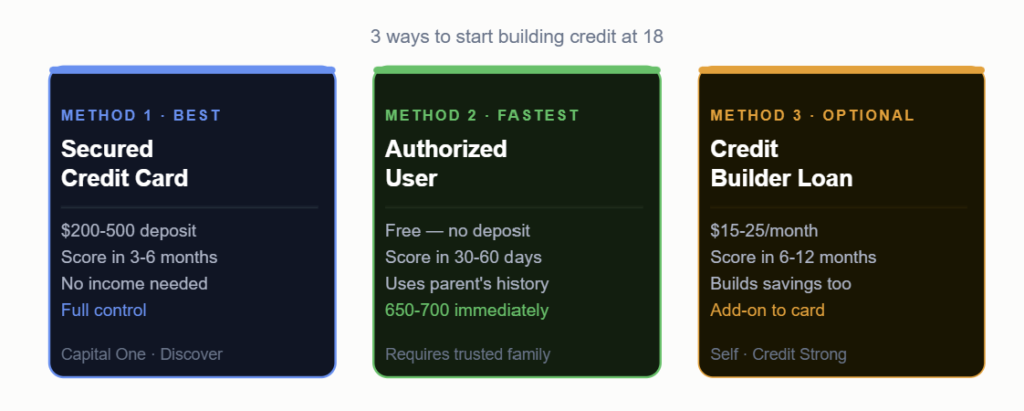
This is what a realistic timeline looks like for someone starting at 18 with a secured card and consistent behavior:
| Timeline | Credit score | What is happening |
| Month 0 | No score | Account opened. Deposit made. Card received. Autopay set up. |
| Month 1-2 | No score yet | Account too new to score. One payment made and reported. History clock starts. |
| Month 3-4 | 630-660 | First FICO score appears. Payment history is 100%. Utilization low. Account age: 3-4 months. |
| Month 6 | 650-690 | Score climbing. Issuer may offer upgrade review. Authorized user history fully reflected if applicable. |
| Month 12 | 680-720 | 12 months of perfect payment history. Account age helping. Score in “good” range. |
| Month 18-24 | 700-750+ | Strong credit established. Eligible for most credit cards and competitive loan rates. |
These ranges are estimates based on typical starting conditions. Your actual score depends on: number of accounts, total payment history, credit utilization at statement date, and whether any negative items (late payments, collections) exist. Starting as an authorized user on a long-standing account can compress this timeline significantly.
The 5 Factors That Determine Your Credit Score
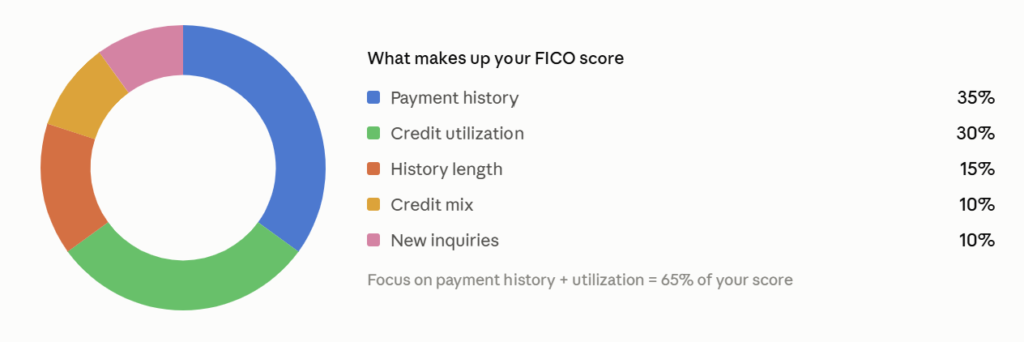
According to the CFPB, FICO scores — the most widely used credit scoring model — are calculated from five factors. Understanding which ones matter most tells you exactly where to focus:
| Factor | Weight | What to do |
| Payment history | 35% | Never miss a payment. Set autopay for the full balance. This is the most important factor by far. |
| Credit utilization | 30% | Keep balance below 30% of limit at statement date. Below 10% is ideal. Pay before the statement closes. |
| Length of credit history | 15% | Start as early as possible. The clock starts when you open the account — not when you first use it. |
| Credit mix | 10% | Having both a credit card and an installment loan (auto, student) helps. Not essential at 18 — do not take on debt just for this. |
| New credit inquiries | 10% | Each hard inquiry drops score by 5-10 points. Only apply for credit when you need it. |
For an 18-year-old, payment history and credit utilization together account for 65% of the score. Master these two and the rest takes care of itself. The deeper breakdown of how utilization works is in credit utilization explained.
5 Mistakes That Set People Back Months or Years
| Mistake | Impact + fix |
| Missing one payment | A single 30-day late payment can drop a new score by 60-100 points and stays on your report for 7 years. Fix: autopay the full balance before the due date. |
| Maxing out the secured card | Using 90%+ of your credit limit dramatically hurts utilization score. On a $300 card, keep balance under $90 at statement close. |
| Closing the secured card when upgrading | Closing an account shortens your credit history. Ask for a product change (upgrade to unsecured) rather than closing and opening new. |
| Applying for multiple cards at once | Each application triggers a hard inquiry. Multiple inquiries in a short period signals financial stress. Apply for one card, use it for 6+ months before applying for another. |
| Paying only the minimum | Paying the minimum keeps you in debt and builds interest charges. Always pay the full statement balance. The goal is credit history, not debt. |
How Long Until You Have Good Credit at 18?
“Good credit” typically means a FICO score of 670 or above. Here is the realistic timeline from the starting line:
| Score range | Typical timeline | What it opens up |
| 630-660 (first score) | 3-6 months | Basic approval for student credit cards, secured card upgrades |
| 670-699 (good) | 6-12 months | Most unsecured credit cards, decent auto loan rates, apartment applications |
| 700-739 (good-excellent) | 12-18 months | Competitive credit card rewards, better interest rates, easier apartment approval |
| 740+ (excellent) | 18-36 months | Best rates on all loan types, premium credit cards, strongest approval odds |
The fastest path to 700+ in under 12 months: open a secured card, become an authorized user on a parent’s long-standing account, keep utilization below 10%, and pay on time every month. For everything beyond 700, how to get a 700 credit score covers the advanced tactics.
Building Credit at 18 Without a Job or Income
A secured credit card does not require income verification — only a deposit. The deposit is your collateral, so the card issuer does not need to evaluate your ability to repay a credit line. This means:
- Birthday money, savings, or a gift can fund your $200-300 deposit
- Part-time work income is not required for approval
- Student loan disbursements can be used as deposit funds
- A parent can gift the deposit amount
Important: Some student credit cards (not secured) do require proof of income or enrollment verification. Secured cards generally do not — they are the most accessible starting point for anyone 18+ regardless of employment status.
If you are in college, some secured cards are specifically designed for students and offer rewards on dining and streaming purchases — categories where students naturally spend. The best credit cards for no credit history compares the current top options side by side.
What to Do After Your First Score Appears
Once you have a score — typically 630-660 after 3-6 months — the next goals are clear:
- Keep paying in full every month. Payment history compounds. 12 months of 100% on-time payments is more powerful than any other single factor.
- Request a credit limit increase at month 6. A higher limit with the same spending lowers your utilization percentage automatically. Most issuers grant increases after 6 months of good behavior.
- Check for a product change offer. Ask your secured card issuer if you can upgrade to an unsecured card. Discover and Capital One typically do this automatically at 6-8 months.
- Add a second credit product carefully. At 12 months with a 670+ score, you can consider a second card. Apply for one with no annual fee that fits how you actually spend — not just the highest sign-up bonus.
- Monitor your credit report annually. Check all three bureaus at annualcreditreport.com (free, official). Look for errors — incorrect late payments, accounts you did not open — and dispute anything inaccurate.
Once you have a score and understand your baseline, how to increase your credit score covers the specific tactics that move the number fastest from good to excellent.
FAQs
How do I start building credit at 18 with no credit history?
The fastest starting point: open a secured credit card with a $200-300 deposit. Capital One Secured and Discover it Secured both have no annual fee and report to all three credit bureaus. Use the card for one small monthly charge, pay the full balance before the due date, set autopay immediately, and keep your balance below 30% of your limit. According to the CFPB, a score typically appears within 3-6 months of opening and using your first credit account.
What is your credit score when you turn 18?
You have no credit score at all when you turn 18 — not a zero, not a bad score. Your credit file is completely empty. Credit scoring models require at least one account to be open for 6 months before generating a score. This is not a penalty — it is a blank slate. Every responsible decision you make from here adds to a completely clean record.
How long does it take to build credit from nothing at 18?
Your first credit score appears in 3-6 months after opening a secured credit card or being added as an authorized user on a parent’s account. A score of 670 (“good” credit) is typically achievable within 6-12 months with consistent on-time payments and low utilization. A score of 700+ usually takes 12-18 months from a clean start. These timelines assume perfect payment history throughout.
Can I build credit at 18 without a job?
Yes. A secured credit card requires a deposit — typically $200-300 — not proof of income. The deposit serves as your collateral, so issuers do not evaluate your employment status for secured card applications. You can fund the deposit with savings, gifts, or any money you have available. Student credit cards sometimes require income verification, but secured cards generally do not.
What credit score does an 18-year-old start with?
An 18-year-old does not start with any credit score. The credit file is empty until the first account is opened and active for 3-6 months. When the first score does appear, it is typically in the 630-670 range for someone who has been making on-time payments with low utilization — not because the score starts low, but because a short credit history limits how high the initial score can climb.
How do I get a 700 credit score at 18?
Reaching 700 at 18 requires: (1) a secured credit card used consistently with full monthly payments, (2) credit utilization kept below 10% at statement closing, and (3) ideally, being added as an authorized user on a parent’s long-standing account with clean history. This combination can produce a 700+ score within 9-12 months. The detailed breakdown is in how to get a 700 credit score.
Does checking your credit score hurt it at 18?
No. Checking your own credit score is a “soft inquiry” and has zero effect on your credit score. You can check it as often as you want without any negative impact. What does hurt your score is a “hard inquiry” — which happens when a lender checks your credit after you apply for a new credit product. Limit hard inquiries by only applying for new credit when necessary.
What is the fastest way to build credit at 18?
The fastest combination: open a secured card today + ask a parent to add you as an authorized user on their oldest credit card. The authorized user status adds their entire credit history to your report immediately, which can produce a score in the 650-700 range within 30-60 days. Then the secured card adds your own independent payment history month by month. Together, these two methods compress the timeline significantly compared to a secured card alone. See the full credit-building guide for every method compared.
Is it too late to start building credit at 18?
No — 18 is actually one of the best ages to start. You have decades ahead before major credit-dependent purchases (house, car loans, refinancing). Every year of credit history you build now works in your favor later. A 28-year-old applying for a mortgage benefits significantly from having 10 years of credit history rather than 2. Starting at 18 gives you a head start that most people wish they had taken.
Sources
1. Consumer Financial Protection Bureau — credit scoring explained and how credit files work
2. Federal Reserve — household credit and consumer finance data
3. FDIC — secured credit card and deposit account guidance
4. Bureau of Labor Statistics — income data for young adults
The Bottom Line
Building credit at 18 requires three things: a secured credit card, one monthly purchase, and full on-time payment every month. That is the entire system. Within 3-6 months you have your first score. Within 12 months you have good credit.
The most important action you can take right now: open a secured card and set autopay for the full balance before the due date. Do not wait until you have a job. Do not wait until you understand every detail. Open the account, set the autopay, and let time do the work.
Once your credit is established, the next step is making sure you know what affects it — the difference between secured and unsecured cards is a common area of confusion that is worth understanding before applying for your first card. And when you are ready to move beyond your starter card, the best credit cards for no credit history shows the current options ranked by fees, rewards, and approval odds.