What if your bank account wasn’t a source of daily anxiety, but a tool that actually let you say “yes” more often? Most of us are told that learning how to manage personal finances means cutting out every small joy, like your morning coffee or dinner with friends. You’re likely staring at student loan balances or wondering how to save when your paycheck feels tiny. It’s exhausting to deal with conflicting advice that makes you feel like you’re already failing. We agree that the stuffy, traditional approach to money is completely broken.
You deserve a system that fits your real life, not a corporate textbook. This guide provides a practical, jargon-free framework to help you master your money without the headache. We’ll walk through how to organize your bank accounts, build a safety net for unexpected repairs, and create a guilt-free way to spend on your favorite hobbies. You’ll finish with a clear path to financial confidence and the control you’ve been looking for. It’s time to stop worrying about your balance and start making your money work for you.
Key Takeaways
- Stop viewing money management as a list of restrictions and start seeing it as a way to spend intentionally on what you actually love.
- Master the essentials of how to manage personal finances by securing a $1,000 starter emergency fund to protect yourself from unexpected costs.
- Identify the best tools for your lifestyle in 2026, whether you prefer the manual control of a spreadsheet or the automation of AI-driven apps.
- Use a 5-step “paycheck sweep” to ensure your rent, utilities, and savings are handled automatically before you spend a single cent on hobbies.
- Learn the specific signs that show you’re ready to move from just staying stable to building long-term wealth and growth.
Why Personal Finance Management Feels Hard (And How to Fix Your Mindset)
School likely taught you how to solve for X or memorize the dates of ancient battles, but it probably skipped the part about how to read a pay stub. This “adulting gap” leaves most 20-somethings feeling behind before they even start. If you’re feeling overwhelmed by student loans or confused by conflicting TikTok advice, you aren’t alone. Learning how to manage personal finances isn’t about memorizing complex math or living a life of total deprivation. It’s about shifting your perspective from restriction to intentionality. You’re simply giving every dollar a job so you can spend guilt-free on the things that actually matter to you.
The biggest trap you’ll face is the belief that you’ll start managing your money once you earn “enough.” This is a dangerous myth. Stability doesn’t come from the size of your paycheck; it comes from the habits you build when that paycheck is small. At Money Under 25, we focus on these small, daily habits that create massive stability over time. For a comprehensive overview of personal finance, you’ll see that the field covers everything from budgeting to saving, but it all starts with your mindset. You don’t need a six-figure salary to be “good with money.” You just need a plan that respects your current reality.
The Psychology of the First Paycheck
When that first “real” deposit hits your account, the urge to spend is almost biological. You’ve worked hard, and you want to see the reward immediately. This often leads to “lifestyle creep,” which is the silent enemy of your bank account. Lifestyle creep is when you upgrade to a $7 daily latte and three new premium streaming subscriptions just because you got a small raise. Before you know it, you’re still living paycheck to paycheck, just with slightly nicer stuff. Spotting this early is the secret to staying ahead of the game.
Setting Realistic Goals for Your 20s
You don’t need to plan your entire retirement today, but you do need to care for “Future You.” We like to use the concept of the 80th birthday party. If you met yourself at age 80, would they be happy with the choices you’re making right now? This doesn’t mean skipping every fun experience. It means balancing your money between three simple buckets:
- Needs: Your rent, groceries, and basic utilities.
- Wants: The things that make life fun, like hobbies or travel.
- Future You: Your savings and debt payments.
Start with short-term wins rather than distant dreams. Your first major milestone should be a $1,000 starter emergency fund. This single number changes your status from being one car repair away from disaster to being in total control. Once you have that cushion, you’ve officially mastered the first step of how to manage personal finances. It’s a small habit that leads to big stability.
The 3 Pillars of a Solid Financial Foundation
Personal finance management is the active oversight of your daily capital. It isn’t a static plan you set and forget. It’s a dynamic process of watching how money enters and exits your life. When you understand how to manage personal finances, you stop reacting to crises and start preparing for them. To do this well, you need to lean on three specific pillars that keep your financial house from falling down during a storm.
- Pillar 1: The Starter Emergency Fund. This is your $1,000 “life happens” buffer. It exists to keep you from using a credit card when your tire blows out or your phone screen shatters.
- Pillar 2: High-Interest Debt Management. Target credit cards and predatory loans with “hair on fire” urgency. You can’t build a future while paying 25% interest on last year’s pizza.
- Pillar 3: The “Boring” Basics. This includes essential insurance and automated savings. If you automate your savings, you remove the temptation to spend that money before it reaches your goals.
The Tiered Emergency Fund Strategy
Most traditional advice tells you to save six months of expenses immediately. That’s a huge mountain to climb when you’re just starting out. Instead, use a tiered approach to build your confidence. Level 1 is that $1,000 buffer. Level 2 is a one-month cushion that covers your basic survival needs like rent and groceries. Level 3 is the full 3 to 6 month fund for long-term stability. This strategy makes the process feel manageable rather than impossible.
Understanding Your Cash Flow
At its core, learning how to manage personal finances comes down to simple math: Income minus Expenses. You need to identify “leaky” expenses in your daily routine. These are the $15 gym memberships you never use or the premium app trials you forgot to cancel. In your first month, tracking every cent is more important than sticking to a strict budget. You can’t fix what you don’t measure. Use our tools for practical capital oversight to see exactly where your cash is going. Once you see the patterns, the leaks are easy to plug. Think of tracking as a diagnostic tool. You aren’t judging your spending yet; you’re just collecting data. Seeing that you spent $200 on takeout in three weeks provides the clarity you need to make a change. It’s the difference between feeling broke and knowing exactly why your balance is low.
The 2026 Toolkit: Digital vs. Manual Money Management
Choosing the right tool is half the battle when learning how to manage personal finances. In 2026, we have more options than ever. You can use classic spreadsheets or AI-driven assistants that predict your spending before it happens. If you love seeing every detail and want total control, a manual spreadsheet is still the gold standard. It forces you to look at every transaction. This builds a deep awareness of your habits that an app can’t always replicate. However, if you find spreadsheets intimidating, you’ll likely stop using them after a week. Consistency matters more than the specific tool you choose.
AI-driven budgeting apps have changed the game this year. These tools analyze your past behavior. They warn you if you’re on track to overspend on groceries or dining out. For absolute beginners, Money Under 25 recommends a hybrid approach. Use a simple app to track daily spending automatically, but perform a manual review once a week. This keeps you engaged without making the process feel like a chore. Pick a tool that matches your financial personality. If you’re a “set it and forget it” person, go digital. If you’re a data nerd, stick to the spreadsheet.
Mastering Subscription Fatigue
It’s easy to ignore a single $9.99 charge. But if you have ten of them, you’re losing nearly $1,200 a year. This is subscription fatigue. It’s a major reason why many young adults feel like their income is too small to manage. Use a digital auditing tool to list every recurring bill on your statement. We suggest making the “Monthly Subscription Purge” a permanent habit. Every thirty days, look at your list and cancel anything you didn’t use at least twice. It’s the fastest way to give yourself a raise without working extra hours.
Automation: The “Set It and Forget It” Rule
Manual intervention is the enemy of consistency. If you have to remember to move money to savings every payday, you eventually won’t. Set up an automatic transfer that triggers the moment your paycheck hits. Moving money into a high-yield savings account is a smart move in 2026, as interest rates remain a key factor for growing your capital. You can also use “Round-up” features in your banking app to save small change while you spend. These tiny amounts add up to hundreds of dollars over a year. When you automate the basics, you’ve mastered a core part of how to manage personal finances. You stop relying on willpower and start relying on a system that works while you sleep.
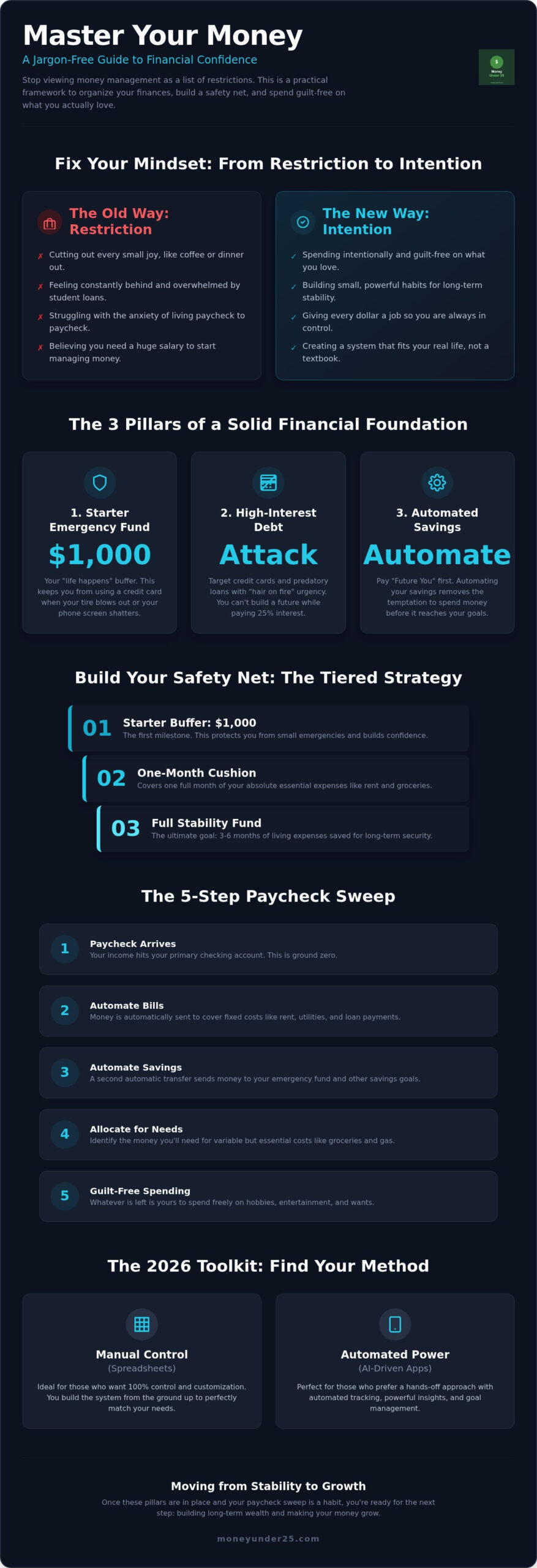
A 5-Step Plan to Manage Your Next Paycheck
When your paycheck hits your account, it’s tempting to treat it like a windfall. But without a specific plan, that money will vanish into a series of small, forgettable purchases. Knowing how to manage personal finances means having a clear order of operations. You need to move through five specific steps the moment you get paid to ensure your bases are covered. This isn’t about being perfect; it’s about being intentional with your capital before you have the chance to spend it impulsively.
Step 1 is the “Immediate Obligations” sweep. This is your survival money. Cover your rent, utilities, and minimum debt payments first. Step 2 is the “Future You” Tax. You must pay yourself before you pay anyone else. Even if it’s just a small amount, move it to your starter emergency fund immediately. Step 3 involves your “Fixed Variable” expenses. These are the things you need, like groceries and transport, where the cost might change slightly each month. Step 4 is your “Guilt-Free Fun” bucket. This is the money you’ve earned for hobbies, social life, or dining out. Finally, Step 5 is the “Leftover” strategy. If you have extra cash at the end of the month, put it toward your highest-interest debt or your next savings milestone.
The 50/30/20 Rule vs. Zero-Based Budgeting
The 50/30/20 rule is a common suggestion, but it doesn’t always work for young adults in high-cost cities. If your rent takes up 60% of your income, those percentages are useless. This is why we recommend Zero-Based Budgeting for absolute beginners. In this system, you give every single dollar a job until you have zero unassigned dollars left. It provides total clarity and ensures no money “leaks” away. As your income grows and your expenses stabilize, you can transition back to a simpler percentage-based approach to save time.
Managing Money with Roommates
Living with roommates can drastically lower your costs, but it can also lead to serious drama. Don’t wait for a conflict to happen. Use apps like Splitwise to track shared household expenses in real-time. We also suggest a “Roommate Financial Agreement.” This is just a simple chat to decide who pays which bill and exactly when the money is due. It keeps your home life peaceful and your credit score safe. For more help building your custom plan, check out our tools for finance management designed specifically for your 20s. Setting these boundaries early prevents the “I’ll get you next time” trap that ruins friendships and bank accounts.
Moving from Stability to Growth: Your Next Steps
Once you have your $1,000 starter cushion and a handle on your monthly bills, you’ve moved past the survival phase. You’ve learned the basics of how to manage personal finances, but now you’re likely wondering when to stop just “managing” and start growing. You’re ready for the next level when your high-interest debt is gone and your paycheck routine feels like second nature. This is where you transition from a checking account mindset to a wealth mindset. Instead of just making sure you have enough for rent, you start looking at how your capital can work for you over the long term.
Money Under 25 focuses on daily habits because they are the foundation of everything else. You don’t need “hot tips” or complex investment theories to succeed. You need the discipline to keep your systems running month after month. Think of financial literacy as a lifelong curriculum rather than a one-time lesson. The goal isn’t just to be stable today; it’s to stay stable for the next fifty years. By mastering the oversight of your daily cash flow now, you’re building a muscle that will support you through every career change or life event that comes your way.
The Power of Compound Interest (Simply Explained)
Time is the most valuable asset you have in your 20s. Because of how math works, $100 saved at age 20 is often worth significantly more than $500 saved at age 40. This is because your money has more decades to grow. Compound interest is like a tiny snowball rolling down a massive hill; it starts small, but as it picks up more snow, it grows into something unstoppable. Don’t get caught up in the “timing the market” debate. “Time in the market” is what actually builds wealth. Start small, start now, and let the clock do the heavy lifting for you.
Staying Consistent When Life Gets Messy
You will have months where everything goes wrong. Maybe your car needs a major repair or you overspend on a friend’s bachelor party. A “bad” money month is not a sign that you’ve failed. It’s just a data point. When this happens, don’t quit your system. Instead, perform a Monthly Financial Health Check. Review your transactions, acknowledge the setback, and reset for the next paycheck. Consistency is about what you do most of the time, not what you do every single day. You’re already ahead of most people your age just by learning how to manage personal finances with intention. Keep showing up for your future self, and the growth will follow naturally.
Take Control of Your Financial Future Today
Mastering your money doesn’t have to be a source of constant stress. By shifting your mindset from restriction to intentionality, you’ve already cleared the biggest hurdle. Remember to prioritize your $1,000 starter emergency fund and use the five-step paycheck sweep to keep your spending on track. These simple habits are the foundation for moving from basic stability to long-term growth. You now have a clear framework for how to manage personal finances without the typical jargon or confusion found elsewhere.
Money Under 25 was founded in 2026 by Simon David to simplify finance for a new generation. We believe in providing practical tools and zero judgment. If you’re ready to stop guessing and start growing, we’re here to help you every step of the way. Start mastering your money today with Money Under 25 and build the life you actually want to live. You’ve got the plan; now it’s time to take the first step toward quiet confidence and total control.
Frequently Asked Questions
How much should I save from my first paycheck?
You should aim to save at least 10% to 20% of your first paycheck, but the specific amount depends on your living costs. If your rent is high, even $50 is a great start. The goal is to build the habit of paying yourself first before you spend on anything else. This small action creates a psychological win that makes learning how to manage personal finances feel much easier and more rewarding over time.
What is the best app for managing personal finances in 2026?
The best app for you depends on whether you prefer automation or manual control. In 2026, AI-driven tools are popular because they predict your spending and warn you before you hit a zero balance. If you want a hands-off approach, choose an app that syncs with your bank account. If you need to feel more connected to your cash, a simple manual tracker or spreadsheet is often the most effective choice for absolute beginners.
How do I manage my money if I have a variable income or side hustle?
You should build your “Immediate Obligations” budget based on your lowest-earning month. This ensures your rent and utilities are always covered. When you have a high-earning month from your side hustle, use that extra capital to beef up your emergency fund or pay down high-interest debt. This baseline strategy prevents you from overextending your lifestyle during peak months and keeps your stress levels low when work inevitably slows down for a few weeks.
Is it better to pay off student loans or save an emergency fund first?
You must save a $1,000 starter emergency fund before you start making extra payments on your student loans. This cushion protects you from taking on new, high-interest credit card debt when life gets messy. Once your starter fund is secure, continue making minimum payments on your loans while you build a one-month survival cushion. This tiered approach ensures you aren’t one flat tire away from a financial setback while tackling your long-term debt goals.
How can I track my spending without it taking hours every week?
You can track your spending in under five minutes a day by using a banking app that categorizes transactions automatically. Instead of a long weekly audit, do a quick daily sweep of your recent purchases while you drink your morning coffee. This prevents the data from piling up and feeling like a chore. Consistency is more important than perfection, so pick a method that feels fast and low-effort for your specific daily lifestyle.
What is a “High-Yield Savings Account” and do I really need one?
A High-Yield Savings Account is a bank account that pays a much higher interest rate than a standard checking account. In 2026, these accounts are essential for your emergency fund because they help your money keep its value against inflation. Think of it as a parking spot for your cash where it earns a small bonus every month just for sitting there. It’s a simple, low-effort way to maximize your practical capital oversight every single day.
Can I still have a social life while managing my finances strictly?
You can definitely have a social life while following a plan. The secret is the “Guilt-Free Fun” bucket. By setting aside a specific amount for dinners and hobbies at the start of the month, you can spend that money without any anxiety. Managing your money isn’t about saying no to your friends; it’s about knowing exactly when you can say yes without hurting your future stability or missing an important rent payment.
What happens if I overspend my budget one month?
You shouldn’t panic if you overspend. It happens to everyone. The most important thing is to acknowledge the mistake and figure out why it happened. Did you have an unexpected car repair, or was it an impulsive shopping trip? Adjust your spending for the rest of the month and reset your plan for the next paycheck. Learning how to manage personal finances is a marathon, and one bad month won’t ruin your long-term progress.