Have you ever reached the end of the month, looked at your bank balance, and wondered where those last few hundred dollars actually went? It is a common frustration to feel like your money is just disappearing into a black hole of subscriptions and takeout. You are likely tired of the paycheck to paycheck cycle and the constant worry that a single flat tire could ruin your entire month. It is hard to feel confident about buying that new pair of shoes when you aren’t sure if the electric bill is fully covered.
The truth is that most traditional advice tells you to save what is left over, but there is rarely anything left. This guide will help you master zero-based budgeting, a straightforward method that turns financial stress into total control. By giving every dollar a specific job before you spend it, you can finally stop guessing and start building a real future. We are going to break down how to track your capital, grow an emergency fund, and decide exactly how much is safe to spend on fun without the lingering guilt.
Key Takeaways
- Assign every dollar a specific task before the month begins to stop the mystery of disappearing cash.
- Create sinking funds for irregular costs like car registration to prevent annual fees from becoming financial emergencies.
- Use zero-based budgeting to give yourself permission to spend on fun items without ever dipping into your rent money.
- Automate your tracking with modern banking buckets and AI-driven apps to keep your plan running in real-time.
- Stabilize variable income from side hustles by using the “last month’s income” rule to fund your current expenses.
What is Zero-Based Budgeting and Why Does It Matter?
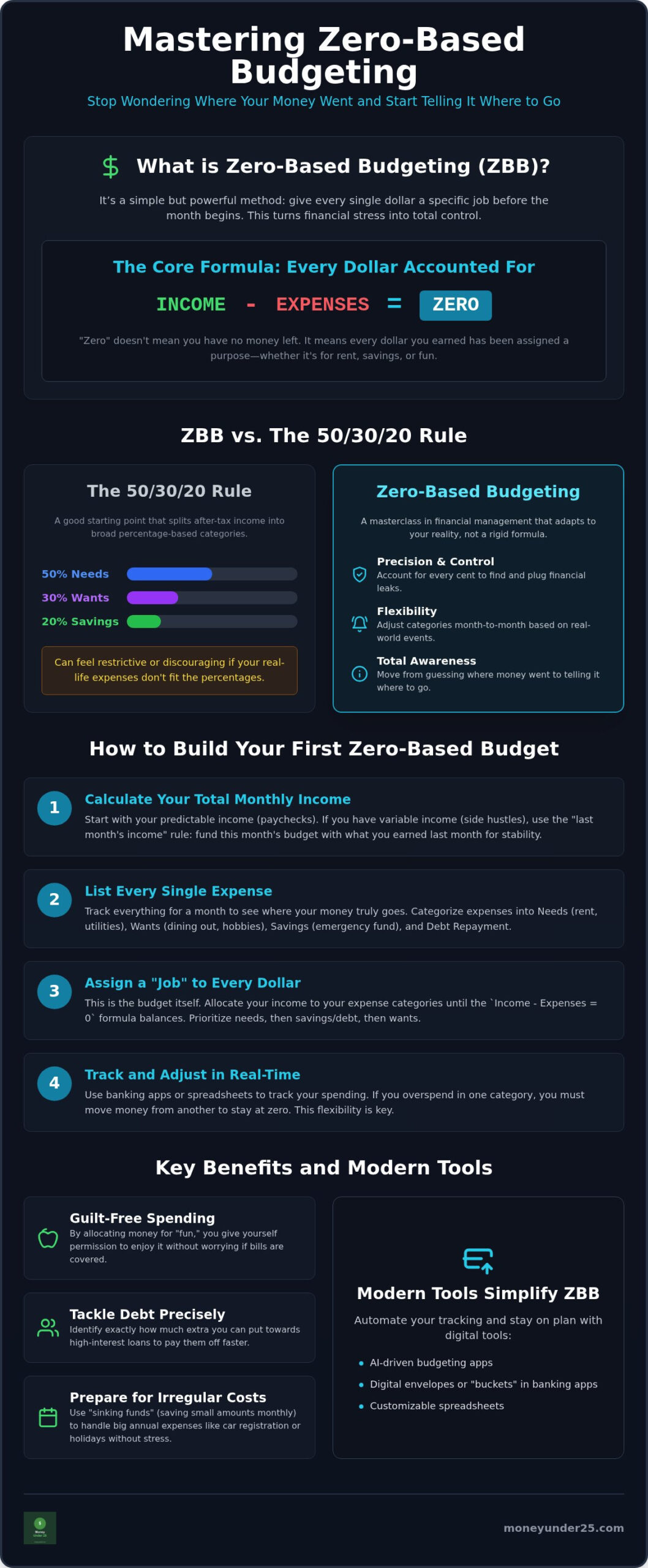
The math behind What is Zero-Based Budgeting is actually quite simple. You take your total monthly income and subtract every single expense until you reach exactly zero. This does not mean you have no money left in your bank account by the end of the month. Instead, it means that every cent you earned has been assigned a specific task. Whether that task is paying rent, buying groceries, or moving money into a high-yield savings account, it is all accounted for before you spend a single dime.
Most people use a reactive approach to their finances. They spend money as needs arise and hope there is something left over for savings. This “set it and forget it” style often leads to that mid-month panic when you realize your balance is lower than expected. Transitioning to zero-based budgeting forces a psychological shift. You move from wondering where your money went to telling it exactly where to go. It turns you into the boss of your bank account rather than a passive observer of your own life.
The “Every Dollar Has a Job” Philosophy
Think of your monthly income as a team of employees. If you don’t give them specific instructions, they will probably just sit around or wander off. When you assign a job to every dollar, you are ensuring that your financial goals are met first. This includes giving yourself permission to spend. One of the biggest hurdles for young adults is the guilt associated with “fun” purchases. When your budget has a specific line item for “Friday Night Out,” you can spend that money with total confidence. You know the rent is covered, the emergency fund is growing, and this specific cash is meant to be enjoyed. It completely eliminates the mystery of your spending habits.
Zero-Based Budgeting vs. The 50/30/20 Rule
You have likely heard of the 50/30/20 rule. It suggests putting 50% of your income toward needs, 30% toward wants, and 20% toward savings. While this is a great starting point, it lacks the precision needed for many entry-level budgets in 2026. If you are living in a high-cost city on a starting salary, your “needs” might take up 65% of your pay. A percentage-based plan can feel discouraging when you can’t hit those exact marks. Zero-based budgeting is the masterclass version of financial management. It adapts to your practical reality rather than trying to fit your life into a rigid formula. You should switch to a zero-base when you are ready to take full control and maximize every bit of capital you have.
- Precision: You account for every cent, which is vital for low-margin budgets.
- Flexibility: You can adjust categories month-to-month based on real-world events.
- Awareness: You become intimately aware of where your leaks are happening.
The Benefits of ZBB for Young Adults in 2026
Living on an entry-level salary in 2026 often feels like a high-stakes balancing act. Between rising rent and the pressure of student loan payments, the paycheck to paycheck cycle is an exhausting reality for many. Zero-based budgeting changes this dynamic by giving you a clear, unapologetic view of your financial boundaries. It allows you to tackle debt with surgical precision. Instead of paying the minimum and hoping for the best, you can identify exactly how much extra you can afford to throw at your highest interest loans each month. This proactive stance significantly reduces the constant background noise of financial anxiety that many young professionals carry daily.
Total transparency is the ultimate goal. When you know exactly where every cent is going, you stop fearing your banking app. This clarity is what allows you to build a substantial emergency fund without feeling like you are missing out on your 20s. You aren’t just saving money for the sake of it; you are buying yourself peace of mind and future flexibility. You are making a plan that respects your current reality while protecting your future self.
Guilt-Free Discretionary Spending
Most budgeting methods feel like a restrictive diet. They focus heavily on what you can’t do, which often leads to burnout. This form of zero-based budgeting is different because it focuses on permission. When you assign money to a “fun” category, that cash is yours to spend without a second thought. You can actually enjoy a weekend trip or a friend’s birthday dinner because you already know the rent, utilities, and grocery bills are fully covered. A key tool here is the “sinking fund.” This is a simple way of saving a small amount each month for a big, future expense. It prevents annual subscriptions or holiday gifts from ever becoming a financial emergency. You are planning for the “oops” moments before they happen.
Early Habit Formation for Long-Term Wealth
There is a common myth that you only need to budget once you are wealthy. The reality is actually the opposite. Managing a $2,000 monthly income perfectly is the best way to prepare for managing $20,000 later in your career. It builds a financial muscle that lasts a lifetime. This intentionality creates a compounding effect on your stability. When you start tracking your personal capital early, you set a foundation for independence that most people don’t find until much later. If you want to dive deeper into these strategies, exploring finance management resources can help you stay on track as your income grows.
How to Build Your First Zero-Based Budget
Building your first budget might feel like a chore, but it’s actually the moment you take the wheel. You aren’t just listing numbers; you’re designing your month. The goal of zero-based budgeting is to make sure every dollar you earn has a purpose before the month begins. This prevents accidental spending from eating your savings. It turns your financial life into a deliberate plan rather than a series of reactions to your bank balance.
Step 1: Identify Every Source of Income
Start by listing everything coming in. This includes your salary from your junior role, any freelance gig payments, and even that $20 your grandma sent for your birthday. Your take-home pay is your net income after taxes are already taken out. If you have irregular pay cycles or side hustle income that fluctuates, use a conservative estimate based on your lowest-earning month to stay safe. It’s better to have a surprise surplus later than a deficit now.
Step 2: List Your Non-Negotiables
Next, write down your mandatory costs. These are things like rent, utilities, basic groceries, and transportation to work. You should also treat your savings as a non-negotiable bill. Paying yourself first ensures that your emergency fund grows before you spend money on non-essentials. Be honest about your food and entertainment targets. If you know you’ll want to grab drinks with friends, give that a specific dollar amount now so you don’t feel guilty when you’re out. This is about practical reality, not perfection.
Step 3: The Final Allocation
Now comes the math. Subtract your expenses from your income. If you have $200 left over, you haven’t reached zero yet. You need to assign that surplus to a specific goal, like extra debt payments or a vacation fund. This is the core of zero-based budgeting; you are making intentional choices before the money is gone. What if you end up in the negative? This is where you perform a budget cut audit. Look at your variable costs, like dining out or streaming services, and trim them until your total hits exactly zero. Finalize this plan before the first of the month so you can hit the ground running.
Life happens in real-time. Your budget isn’t a static document; it’s a living plan. If an unexpected bill pops up, you simply move money from one category to another to cover it. This keeps you in control without breaking your overall strategy. You stay flexible while keeping your eyes on the goal.
Modern Tools to Simplify Your Budgeting Process
You don’t need a physical ledger or a complex math degree to make zero-based budgeting work in 2026. While manual spreadsheets offer incredible control, they can be slow to update when you are on the move. Modern finance management apps have stepped in to bridge that gap. They automate the boring parts of tracking so you can focus on making decisions. If you want to succeed, you need a system that fits into your actual daily routine rather than forcing you to change your life for a piece of software.
Modern banking has evolved to mirror the zero-base philosophy. Many fintech platforms now offer “buckets” or “vaults” that allow you to partition your money within a single account. This is a digital version of the classic envelope system. When your paycheck hits, you can immediately slide funds into these buckets for rent, groceries, and savings. AI-driven tools can even analyze your spending history to predict when variable costs, like a summer cooling bill, might increase. This predictive power allows you to adjust your plan before you are ever caught off guard.
Digital Envelopes and App Integration
Connecting your bank accounts to a tracking tool provides real-time visibility that a manual sheet just can’t match. You can set up custom alerts that notify you the moment you spend 80% of your entertainment budget. This prevents the “oops” moments at the end of the month. Many young professionals find success with a hybrid approach. They use a detailed spreadsheet to map out the month on the 1st, then use an app for quick entries and balance checks throughout the weeks. It keeps the strategy solid while making the execution fast.
Choosing the Right Software for Your Style
Your choice of tool depends on how you process information. Visual learners often prefer apps with progress bars and color-coded charts that show exactly how much “job” is left for their dollars. Data enthusiasts might prefer tools that offer deep-dive reports and exportable files. When deciding between free and paid options, consider the return on investment. If a subscription costs a few dollars but saves you from one $40 overdraft fee, it is a smart move for your stability. Check out our guide to the best budgeting tools to see which ones we recommend for your specific needs. Start by exploring our latest finance management resources to see how these tools integrate with your long-term goals.
Advanced ZBB Tactics: Variable Income and Roommates
Life rarely fits into a perfect box. While we have covered the foundations of how to build your plan, you might be wondering how to handle the messy reality of freelance gigs or split rent. Zero-based budgeting is flexible enough to handle these hurdles if you use the right tactics. You don’t need a corporate salary to have total control over your capital. You just need a strategy that accounts for the “what ifs” before they happen.
Unexpected costs are a part of life, not a failure of your system. If you experience a “budget leak,” such as an emergency vet visit or an impulsive night out, don’t scrap the whole month. Simply move money from a lower priority category, like your clothing fund, to cover the gap. You should also look ahead at the calendar for months with five Fridays. These months often mean an extra week of groceries or gas, so adjust those categories upward on the first of the month to stay ahead of the curve.
Budgeting on a Fluctuating Income
If your income changes every month, you can still find stability by using the “Last Month’s Income” rule. Instead of guessing what you will earn in July, you use the actual cash you brought home in June to fund your July budget. This creates a powerful buffer that eliminates the stress of waiting for a client to pay a late invoice. If you are just starting out and don’t have a month of savings yet, build a “Baseline Budget” that covers only your absolute essentials. Anything you earn above that baseline can then be funneled into a “Hill and Valley” fund to smooth out the months when work is slow. To stay on top of your obligations, you should set up a separate holding account to save 25% of every gig payment specifically for your upcoming taxes.
Roommates and Shared Expenses
Living with roommates often means one person pays the utility bill while the others Venmo their share. This can make your bank balance look confusing if you aren’t careful. The best way to handle this is to track those Venmo requests as “Expected Income” in your monthly plan. When you pay the full $150 internet bill, you immediately record the $100 you are owed from your two roommates as incoming cash. This keeps your personal zero-based budgeting accurate and prevents you from feeling “poor” when you are actually just waiting for a transfer. Learn how to manage money with roommates to ensure your shared house funds never mess up your individual financial goals. Keep your personal budget strictly separate from communal house accounts to maintain total clarity.
Take Control of Your Financial Future
You now have the framework to stop wondering where your money goes and start telling it where to stay. By mastering zero-based budgeting, you are building a foundation of stability that will serve you throughout your entire career. You have learned how to allocate every cent, use modern fintech tools to your advantage, and handle the messy reality of roommates and side hustles with confidence. This isn’t about restricting your life; it’s about giving yourself permission to spend on what truly matters to you.
Financial independence is a journey, and you don’t have to walk it alone. We focus on the specific hurdles young adults face, providing practical, jargon-free guidance to help you build real wealth. Our mentor-led approach ensures you have the support you need to turn abstract theory into a practical reality. Ready to take the next step? Start mastering your personal capital with our Finance Management 101 guide today. You have the tools and the plan. Now, it’s time to put them into action and build the life you want.
Frequently Asked Questions
Does zero-based budgeting mean I have $0 in my bank account?
No, it doesn’t mean your balance is empty. It means your income minus your expenses equals zero by the time you’ve assigned every dollar a job. You still have money in your checking and savings accounts for bills and goals. The “zero” refers to the planning stage where every cent is accounted for. If you have $3,000 in your account but you’ve assigned all of it to categories, your budget is zero-based.
How much time does zero-based budgeting take each month?
You can expect to spend about an hour setting up your initial plan before the month starts. Once you are in a rhythm, weekly check-ins usually take about 10 to 15 minutes. Using zero-based budgeting becomes faster as you get used to your spending patterns. Automating your transaction tracking with an app can cut this time down even further, making it a very low-effort habit for the total control it provides.
Can I use zero-based budgeting if I have a lot of debt?
Yes, it is actually one of the most effective tools for paying down debt quickly. Because you are accounting for every single cent, you often find money that was previously being wasted on mindless purchases. You can then direct that extra capital toward your highest-interest loans. This method gives you a clear timeline for when you will be debt-free, which provides a massive boost to your confidence and motivation.
What happens if I overspend in one category?
If you overspend in one category, you simply move money from another category to cover the difference. This is often called “rolling with the punches.” If you spent $20 too much on groceries, you might take $20 out of your entertainment fund for that month. The goal is to keep the total at zero. It keeps you honest about your choices without making you feel like you have failed your entire plan.
Is zero-based budgeting better than the 50/30/20 rule?
It depends on your goals, but zero-based budgeting offers much more precision than the 50/30/20 rule. While percentages are a good general guideline, they don’t help much if your rent is high or your income is low. ZBB forces you to look at your actual costs rather than abstract ratios. It is usually the better choice for anyone who wants to maximize their savings or get out of debt as fast as possible.
How do I handle irregular bills like car registration or annual fees?
You handle these using sinking funds, which are small amounts saved monthly for a future expense. If your car registration is $240 a year, you simply add a $20 “bill” to your budget every month. By the time the registration is due, the money is already there waiting for you. This prevents those irregular costs from feeling like an emergency or ruining your financial plan for that specific month.
Do I need a special app to do zero-based budgeting?
You don’t need a specific app, though many people find them helpful for real-time tracking. You can successfully run a zero-base plan using a simple spreadsheet or even a piece of paper and a pen. The most important part is the methodology, not the software. If you prefer a manual approach, just make sure you are diligent about recording your transactions so the jobs you’ve assigned to your dollars stay accurate.
What should I do with the “extra” money in a month with three paychecks?
You should treat that third paycheck as a huge opportunity to reach your goals faster. Since your monthly bills are likely already covered by your first two checks, you can assign the bulk of that extra money to debt or your emergency fund. Don’t let it sit in your account without a job, or it will likely disappear into small, unplanned purchases. Give it a specific purpose before the money hits your bank.