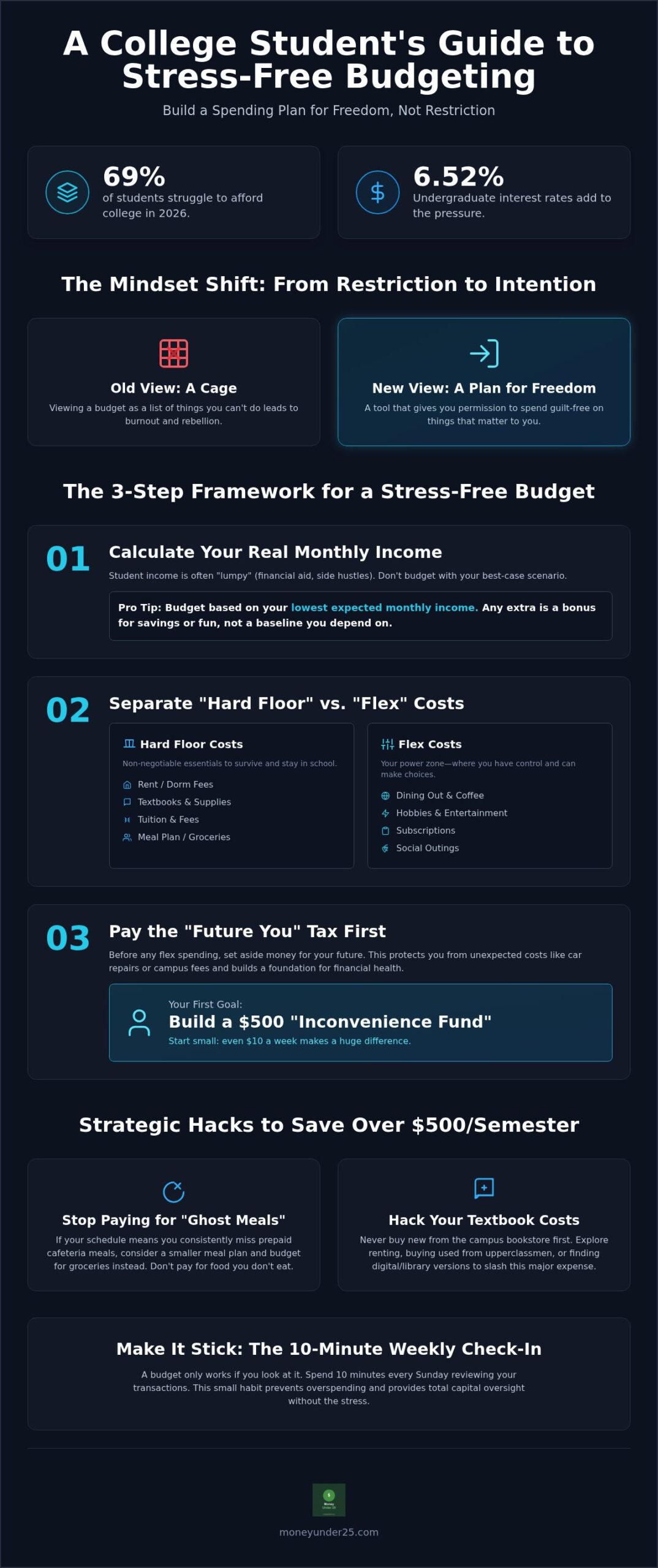
What if your budget was the secret to saying “yes” to more concerts instead of the reason you’re staying home? In 2026, 69% of students say they struggle to afford college, and it’s easy to see why. Between undergraduate interest rates hitting 6.52% and the constant pressure to spend on social outings, finding the right college student budgeting tips feels like a necessity for survival. You’re probably tired of the stress that comes with balancing financial aid against your actual living costs and those unexpected campus fees.
We believe budgeting should fund your freedom, not restrict it. This guide shows you how to build a realistic, stress-free system that protects your social life while securing your financial future. You’ll learn how to manage your cash flow, build an emergency fund for late-night car repairs, and graduate with a healthy credit score. Let’s move from financial uncertainty to quiet confidence with a plan that actually works for your life.
Key Takeaways
- Reframe your budget as a “spending plan for freedom” that helps you say yes to social outings instead of a list of restrictions.
- Apply our 3-step framework to identify your “Hard Floor” survival costs and protect your flexible spending for things you actually enjoy.
- Discover the best college student budgeting tips for choosing between automated apps and manual spreadsheets based on your personal habits.
- Stop overpaying for “ghost meals” and textbooks by using strategic campus hacks that can save you over $500 every semester.
- Build a sustainable $500 “Inconvenience Fund” and use a 10-minute weekly check-in to maintain total capital oversight without the stress.
Why Most College Budgets Fail (And the Mindset Shift You Need)
Why do most college student budgeting tips fail before the first month ends? It isn’t because you’re bad at math. It’s because most people view a budget as a cage. If you think of money management as a list of things you aren’t allowed to do, you’ll eventually rebel against it. This is why we need to redefine what a personal budget is from the ground up. It’s not a restriction; it’s a spending plan for your freedom.
Many students suffer from the “Ostrich Effect.” This happens when you stop checking your banking app because you’re afraid of what you’ll see. You hope that by ignoring the balance, the problem will go away. In reality, this only makes the anxiety worse. Knowing exactly where you stand gives you power. It’s also vital to know the difference between being “broke” and being “illiquid.” You might be broke, meaning you have zero dollars to your name. Or, you might be illiquid, meaning you have money in a savings account or a paycheck coming Friday that you simply can’t spend right now. Understanding this helps you time your spending without hitting a panic button.
Moving from Restriction to Intention
Saying “no” to every coffee run or weekend trip is a fast track to budget burnout. You can’t live like a hermit for four years. A budget is a tool that gives you permission to spend your money on the things that actually matter to you. Instead of cutting everything out, you prioritize your “fun money” after your essentials are covered. When you know your rent and books are handled, you can spend that remaining $40 on a night out without a hint of guilt. Remember that every $20 you spend on campus has an “opportunity cost.” If you spend it on a mediocre cafeteria sandwich today, you can’t spend it on that concert ticket tomorrow. Choose the things that bring you the most value.
The 2026 Economic Reality for Students
In 2026, money is more invisible than ever. Between Spotify, gym memberships, and AI study tools, subscription-based living can drain your account before you even wake up on the first of the month. Digital payments like Apple Pay and Venmo make it dangerously easy to tap your phone and forget the transaction ever happened. This “frictionless” spending is exactly why manual tracking is more important now than it was a decade ago. If you don’t physically see the money leaving your hands, you’re more likely to overspend. Real college student budgeting tips focus on making your spending “felt” again so you stay in total control of your capital.
The 3-Step Framework for a Stress-Free Student Budget
Building a budget shouldn’t feel like doing your taxes. It’s about giving every dollar you earn a specific job before the month begins. This method, often called zero-based budgeting, is one of the most effective college student budgeting tips for staying in control. When your income minus your expenses equals zero on paper, you know exactly where your capital is going. You aren’t just “hoping” there’s enough left for pizza on Friday. You’ve already decided there is.
Calculating Your Real Monthly Income
Most students don’t have a steady bi-weekly paycheck. You might receive a large financial aid refund in September, occasional help from parents, or “lumpy income” from a side hustle. To make this work, budget based on your lowest expected monthly income. If you usually make $600 a month but sometimes hit $800, use $600 as your baseline. Any extra becomes a bonus for your savings. If you’re feeling overwhelmed by the math, the Federal Student Aid budgeting guide offers great templates for tracking these irregular cash flows.
Hard Costs vs. Flex Costs
Your “Hard Floor” consists of the absolute minimums you need to survive and stay in school. This includes rent, meal plans, and those mandatory textbooks. These are non-negotiable. “Flex Costs” are the areas where you actually have power. This covers dining out, hobbies, and weekend trips. While the traditional 50/30/20 rule suggests spending 50% on needs, 30% on wants, and 20% on savings, it’s often unrealistic for students. Your “needs” might take up 80% of your small paycheck. That’s okay. The goal is oversight, not perfection. Categorize your spending so you can see exactly which “flex” habits are eating your future freedom.
Finally, don’t forget the “Future You Tax.” Even if it’s only $10 a week, setting aside money for an emergency fund or graduation expenses is vital. It protects you from late-night car repairs or sudden campus fees. At Money Under 25, we specialize in helping you build these small-step habits that lead to long-term independence. Once you handle the “Hard Floor” and the “Future You Tax,” the rest of your money is yours to spend without the typical student guilt.
Choosing Your Tools: Apps vs. Spreadsheets for Gen Z
You’ve got your framework, but where do you actually track the numbers? At Money Under 25, we believe the best tool is simply the one you’ll actually open. It doesn’t matter if it’s a high-tech app or a simple notebook as long as it gives you capital oversight. Choosing the right platform is one of the most practical college student budgeting tips because it determines whether you’ll stick with the habit or quit by week three.
The Case for Budgeting Apps
Apps are built for speed. They offer real-time tracking and automatic categorization, which is a lifesaver if you’re busy with 18 credits and a part-time job. Look for apps that support zero-based budgeting and don’t charge a monthly fee. Many free versions provide exactly what you need without the bloat of premium financial planning tools. However, automation can lead to “passive” management. If the app does everything for you, you might stop looking at the numbers entirely. You should also consider security. Most modern apps use bank-level encryption, but you must decide if you’re comfortable linking your accounts to a third-party service. If you prefer a hands-off approach that keeps you updated on the go, an app is your best bet.
The Case for Manual Spreadsheets
If you want complete customization, go for a spreadsheet. You can build it exactly how you want without being forced into someone else’s categories. The biggest pro is forced awareness. When you have to type in every $6 coffee purchase, you feel the impact immediately. This is what we call the Friction Benefit. The Friction Benefit is the intentional resistance created by manual entry that forces you to acknowledge every transaction instead of swiping on autopilot. It turns a mindless tap into a conscious decision. The downside is that it takes 30 to 60 minutes a week to maintain. If that feels like a chore you’ll avoid, a spreadsheet might not be the right fit for your current lifestyle.
For those who struggle with digital overspending, the old-school cash envelope method is still one of the most reliable college student budgeting tips. It’s impossible to overspend when the physical envelope is empty. This tactile approach pairs well with the mindset shift we discussed earlier, making your money feel real again. No matter what you choose, the goal is to stop guessing and start knowing where your money goes. Pick the tool that feels easy to use and stick with it for at least one full semester.
Strategic Spending: How to Hack Your Biggest Campus Expenses
Once you have your framework and tools ready, it’s time to tackle the “big leaks” in your bank account. These are the recurring campus costs that feel mandatory but often have hidden workarounds. Applying a few strategic college student budgeting tips here can save you thousands of dollars over four years. It isn’t about deprivation; it’s about being smarter than the system designed to take your cash.
Start with the “Textbook Trap.” Buying brand-new books from the campus bookstore is the fastest way to lose money. You can often save $500 or more per semester by renting or buying used, older editions. Unless you need a specific digital access code, the content in a three-year-old biology book is usually identical to the latest version. Next, look at your meal plan. Are you paying for “ghost meals” you never actually eat? Many students pay for a 21-meal-per-week plan but only use 14. If your school allows it, downgrade your plan and use the saved capital for groceries or flex spending.
Your .edu email address is actually your most valuable financial asset. Before you buy anything, from software to sneakers, check for a student discount. Many retailers offer 10% to 20% off just for having a college email. To curb impulse spending on Amazon or TikTok Shop, use the “24-Hour Rule.” If you see something you want, add it to your cart but don’t check out. If you still want it 24 hours later, and it fits within your flex spending, go for it. Most of the time, the urge to buy disappears overnight.
Transportation and Social Life
Bringing a car to campus is a massive financial burden. When you factor in insurance, gas, and parking permits that can cost $300 or more, the true cost is staggering. If your campus is walkable or has a good bus system, leave the car at home. When it comes to your social life, you don’t need a $50 bar tab to have fun. Embrace “potluck” culture by hosting movie nights or game sessions in your dorm. If friends invite you out and you’re at your limit, just be direct. Say, “I’m on a budget this week, but I’m down to hang out at the lounge later.” True friends will respect your honesty.
Side Hustles and Capital Oversight
A part-time job can provide much-needed breathing room, but it shouldn’t tank your GPA. Look for high-impact side hustles like tutoring, freelancing, or campus research assistantships. these roles often pay better and look more impressive on a resume than basic retail work. Check out our guide on side hustles for students to find a gig that fits your schedule. Remember, the goal of a side hustle is to increase your independence, not to increase your stress. If you’re ready to take full control of your money, start using our finance management tools to track every dollar you earn.
Beyond the Spreadsheet: Building a Sustainable Money Habit
A budget is only as good as the habit behind it. You can have the perfect app or spreadsheet, but if you don’t open it, your capital oversight will vanish. Building a sustainable routine is the most important of all college student budgeting tips. It moves you from reacting to financial problems to predicting them. Start with a “10-Minute Sunday Check-In.” Every Sunday evening, review your transactions from the past week. Did you stay within your flex spending? Did an unexpected subscription hit your account? This quick review keeps your money top-of-mind without the stress of a deep dive.
Next, build an “Inconvenience Fund.” This is a starter emergency fund of at least $500. We call it an inconvenience fund because most student emergencies, like a flat tire or a broken laptop screen, are just expensive annoyances. Having this cash tucked away prevents a small problem from becoming a total disaster. Try to automate your savings to reach this goal. Even if it’s only $5 a week, set it to move automatically from your checking to your savings. You won’t miss the five dollars, but you’ll certainly value the peace of mind it buys. If you experience a “Budget Blowout” where you overspend on a weekend, don’t give up. Acknowledge the slip, adjust your flex spending for the next week, and keep going. Consistency beats perfection every single time.
Tracking Progress, Not Just Pennies
Budgeting feels better when you celebrate wins. Set “Milestone Rewards” for yourself. When you hit that $500 Inconvenience Fund, treat yourself to a small reward like a movie night. It’s also helpful to view your degree as a future asset. While your bank account is small now, you’re building massive earning potential. Use Money Under 25 tools to track your long-term growth and see how these small habits add up over time. Seeing your progress visually makes it much easier to stay motivated.
Preparing for Life After Graduation
The college student budgeting tips you master now are the exact same skills you’ll need for your first salary. If you can manage $1,000 a month in college, you’ll be a pro at managing $5,000 a month later. The biggest trap for new grads is “Lifestyle Creep.” This is when you spend every cent of your first big paycheck on immediate upgrades. By keeping your student habits for just one year after graduation, you can secure your financial future for decades. Start your journey toward financial independence today. Your future self will thank you.
Take Control of Your Financial Future
Mastering your money doesn’t mean giving up your social life. It means knowing exactly where your cash goes so you can spend it on the things that actually matter. By shifting your mindset from restriction to freedom and building a $500 Inconvenience Fund, you’re already ahead of the curve. These college student budgeting tips are designed to fit the reality of campus life in 2026, helping you move from financial stress to total confidence.
Real progress comes from consistent, small habits like the Sunday check-in. You don’t need complex formulas or dry, formal advice. You just need a practical system that works for your specific situation. Simon David built this platform to provide pragmatic guidance specifically for the under-25 demographic. We focus on no jargon and real results that help you secure your independence before graduation day arrives.
Ready to stop guessing and start growing? Master your money today with Money Under 25. You have the tools and the strategy; now it’s time to take the first step toward a secure financial future. You’ve got this.
Frequently Asked Questions
How much should a college student spend on groceries per month?
Monthly grocery spending varies, but most students aim for $250 to $400 depending on their location and dietary needs. If you have a meal plan, this number should be much lower. Focus on buying versatile staples like rice, beans, and frozen vegetables to keep costs down. Bulk buying with roommates is another effective way to slash your bill. Tracking these costs is a core part of effective college student budgeting tips.
Is it better to use a credit card or debit card in college?
Use a debit card for daily spending to avoid debt, but consider a student credit card for small, fixed expenses to build your score. Charging one subscription to a credit card and paying it off monthly establishes a healthy credit history. It helps you graduate with a score that makes renting an apartment easier. Just ensure you never carry a balance, as interest rates can quickly wipe out any benefits.
How can I save money on textbooks in 2026?
Look beyond the bookstore by checking for Open Educational Resources (OER) or your campus library’s reserve shelf. Many professors keep a copy of the required text at the library for students to use for free. You can also use price comparison sites to find the lowest rental rates across the web. Buying an international edition is another secret hack to get the same content for a fraction of the sticker price.
What is the best budgeting app for students with no income?
The best tool for students with zero income is a simple, manual spreadsheet or a free zero-based budgeting app. Since you aren’t tracking a steady paycheck, you need a system that focuses on managing the lump sums you do have. Manual entry forces you to be mindful of every dollar leaving your account. This awareness is more valuable than any automated feature when your funds are extremely limited.
How do I budget if my parents pay for some of my expenses?
Treat parental support like any other form of income by adding it to your monthly total. If they pay your rent directly, you don’t need to list that expense, but you should track the cash they send for food or gas. This gives you a clear picture of your actual purchasing power. Knowing exactly what you have prevents you from overspending your own hard-earned paycheck or financial aid refund.
Should I take out extra student loans to cover living costs?
Avoid taking out extra loans for living costs if possible, as undergraduate federal interest rates are 6.52% for the 2026-2027 year. Borrowing $1,000 today could cost you significantly more by the time you pay it back. Exhaust all other options like part-time work or cutting “flex” costs first. Only use loans for absolute essentials that your current income or savings cannot cover to keep your future debt manageable.
How do I save for an emergency fund while I’m in school?
Start small by setting aside $5 to $10 every week from your paycheck or side hustle. You can also build your $500 Inconvenience Fund by selling clothes you no longer wear or items from your dorm you don’t use. Many banking apps offer a “round-up” feature that saves the change from every purchase automatically. These tiny amounts add up quickly without making you feel like you’re missing out on campus life.
What is the 50/30/20 rule and does it work for students?
The 50/30/20 rule allocates 50% to needs, 30% to wants, and 20% to savings, but it’s often difficult for students to follow. Most college student budgeting tips suggest a modified version, like 80/10/10, where 80% goes to survival. Don’t stress if your percentages don’t match the traditional model. The most important thing is that you’re tracking your capital and making intentional decisions about where every single dollar goes.