What if the rent listed on your screen is only 60% of the actual cost to keep your keys? Most first-time renters focus on that one big number and end up “house poor” before the first month is even over. If you’re feeling anxious about credit scores or hidden fees, you’re not alone. The process feels like a gauntlet of $50 application fees and $2,000 security deposits. Mastering budgeting for your first apartment is about more than just surviving; it’s about making sure you still have money for a life outside those four walls.
You deserve to feel like a confident adult when you sign that legal contract, not like you’re one flat tire away from financial ruin. Think of this as your first major finance management project. This guide will show you exactly how to calculate your real rent ceiling and build a savings goal that covers every upfront cost. We’ll look at the 2026 rental market, from $15 renter’s insurance policies to the truth about utility bills. By the end, you’ll have a clear monthly spending plan that leaves room for fun while giving you total control over your new home.
Key Takeaways
- Aim for a rent ceiling based on your take-home pay rather than your gross income to keep your lifestyle fun and affordable.
- Calculate your move-in fund using the “Three Months of Rent” rule to cover every deposit and fee when budgeting for your first apartment.
- Build a checklist of recurring monthly costs like renter’s insurance and utilities to avoid any bank account surprises after you move in.
- Follow a tiered furnishing plan that focuses on the essentials first, allowing you to fill your space over time without going into debt.
- Switch from a “saving to move” mindset to active finance management to track variable bills and stay in control of your new independence.
Calculating Your ‘Real’ Rent Ceiling
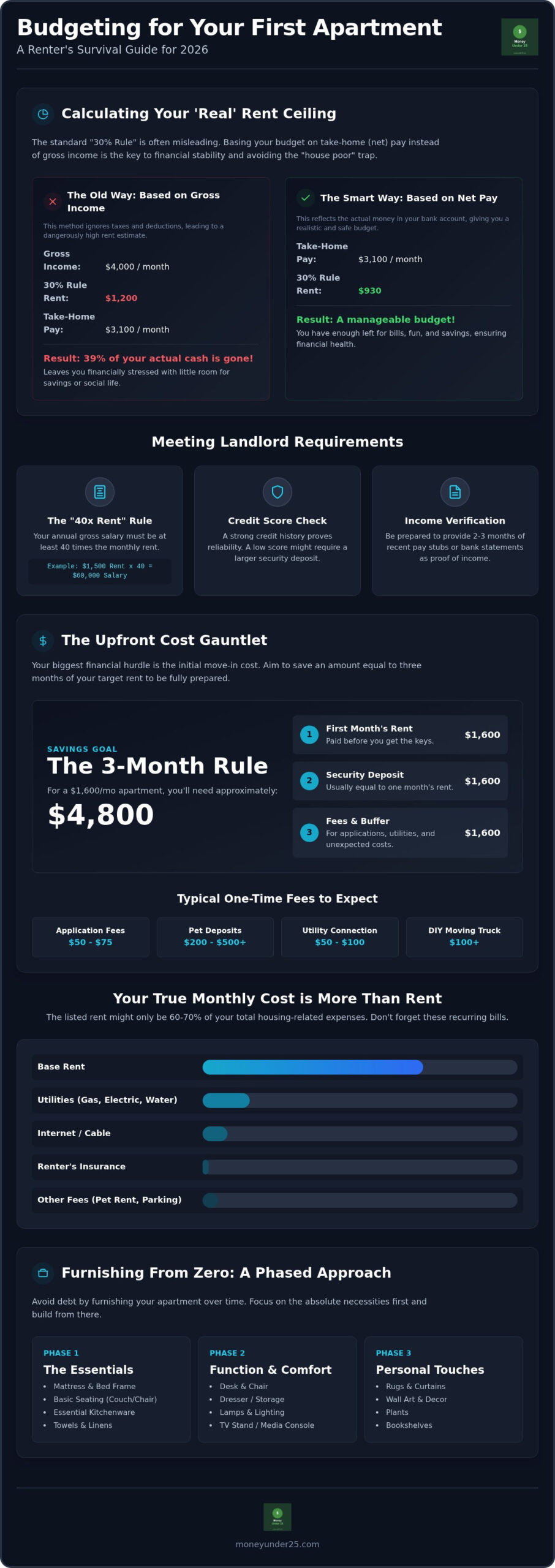
The 30% rule is the classic starting point for budgeting for your first apartment. It suggests you should spend no more than 30% of your gross income on rent. While this sounds simple, it often ignores the reality of your personal budget and the taxes taken out of your paycheck. If you earn $4,000 a month before taxes, the rule says you can afford $1,200. But if your take-home pay is actually $3,100, that $1,200 rent suddenly eats up nearly 40% of your actual cash. Using your net pay as a metric is much safer. It ensures you have enough left for groceries, gas, and a social life without feeling “house poor.”
In 2026, the rental market is shifting in ways that require a sharp eye on your finance management. With a national average rent of $1,663 for a one-bedroom, finding a spot that fits the 30% rule in urban centers is getting harder. Since new apartment construction has slowed to about 250,000 units this year, demand is driving prices up, especially in cities like Brooklyn and Chicago where rents rose 4.8% recently. You also need to look at your debt-to-income ratio. If you have heavy student loans or a car payment, your “real” rent ceiling might be lower than a standard calculator suggests. Landlords use this ratio to see if you can actually handle the lease without defaulting.
The 30% Rule vs. Reality
If you’re looking in a high-rent city, you might have to stretch your expectations to 35% or 40% of your income. This is where a co-signer comes in. A co-signer is typically a parent or guardian who signs the lease with you, promising to pay if you can’t. It’s a common way for young adults to get approved when their income doesn’t quite meet a landlord’s strict math. For 2026, the Rent-to-Income ratio is a simple calculation where you divide your monthly rent by your monthly gross income to determine if a property fits your financial profile.
Income Verification and Credit Scores
Landlords want proof that you’re a reliable tenant. They’ll ask for two to three months of pay stubs or bank statements to verify your income. Most management companies follow the “40x Rent” rule, meaning your annual salary must be at least 40 times the monthly rent. If a studio costs $1,500, you need to earn $60,000 a year to qualify. Your credit score also plays a huge role in the approval process. While we don’t provide credit repair, it’s a fact that a lower score might lead a landlord to ask for a larger upfront deposit, sometimes doubling your initial move-in cost.
The Upfront Cost Gauntlet: First Month Expenses
Many first-time renters fall into the “first-month trap.” They save just enough for the first month’s rent and are shocked when the landlord asks for three times that amount up front. When budgeting for your first apartment, you must separate startup costs from recurring bills. Startup costs are one-time hits to your wallet, like application fees and furniture. Recurring bills are the monthly obligations like rent and internet. To survive this transition, follow the “Three Months of Rent” rule. Before you even look at a floor plan, aim to have a savings balance equal to three times your target rent. This covers your first month, a security deposit, and the inevitable “oops” expenses that pop up during the move.
Application fees are the first hurdle. In 2026, the median fee is around $50 per person, though it can climb to $75 in competitive cities. Landlords use these to pay for background and credit checks. If you have no rental history, be prepared for a higher security deposit. While states like New York and California cap deposits at one month’s rent, others like Pennsylvania allow up to two months for the first year. Landlords see first-time renters as a higher risk; they use these deposits as a financial safety net. Using finance management tools can help you visualize this savings goal so you don’t get caught off guard by these initial demands.
Deposits and Fees You Can’t Avoid
- Security Deposits: Protect this money. Take photos of every scratch or stain on move-in day so you can prove you didn’t cause the damage when you eventually move out.
- The Pet Tax: Bringing a dog? You might face a one-time pet deposit plus “pet rent,” which is a monthly fee added to your base rent.
- Utility Connections: Power and water companies often charge a $50 to $100 connection fee just to turn the service on in your name.
Logistics: The Cost of Moving Day
Moving day itself is a line item you can’t ignore. A DIY truck rental might cost $20 to $100 plus mileage, while professional movers can easily run into the thousands. If you’re on a budget, source boxes for free from liquor stores or grocery chains. Don’t pay $3 for a piece of cardboard you’ll throw away in a week. Finally, keep a cash buffer for moving day. Between tipping the crew and buying pizza for the friends who helped you haul boxes, those small costs add up fast. Staying organized with your spending now prevents a major headache later.
Monthly Recurring Costs You Can’t Ignore
Monthly bills are the heartbeat of your new life. After you’ve cleared the hurdle of move-in fees, you face the long game of staying financially stable. Budgeting for your first apartment isn’t just about the rent check. It’s about the five or six other payments that keep your lights on and your food cold. One cost that is absolutely non-negotiable is renter’s insurance. For roughly $15 to $24 a month, you get coverage for your personal property and liability. Many landlords in 2026 require this before they even hand over the keys. It’s a tiny price to pay to avoid a $20,000 disaster if a pipe bursts above your bed.
Watch out for the “amenity fee” trap. Modern complexes often tack on charges for things you might not even use, like a rooftop lounge or a shared workspace. These can add $50 to $100 to your monthly bill. Always ask for a breakdown of every fee before you sign. If the complex has a “trash valet” service, you might be forced to pay $25 a month just for someone to pick up your garbage at your door. These small charges are where your budget can start to bleed out if you aren’t careful. Being aware of these line items now prevents a “house poor” situation later.
Utilities and Connectivity
Most leases today leave electricity and internet to the tenant. If you’re working from home, high-speed internet is a utility, not a luxury. Budget $60 to $100 for a reliable connection. For electricity, a good rule of thumb is to estimate about $1 to $1.50 per square foot depending on your climate and how much you use the AC. If your unit is 700 square feet, expect a $70 to $100 bill. Don’t forget parking fees. In urban areas, a dedicated spot can cost an extra $150 a month, which is a massive jump from the free street parking you might be used to.
Lifestyle and Maintenance
Living on your own means buying your own toilet paper, dish soap, and lightbulbs. These household maintenance items can cost $40 a month. Groceries are another major shift. It’s easy to spend $400 a month on food if you aren’t planning. Try to cook at home five nights a week to keep your food budget under control. Finally, start an “Emergency Apartment Fund.” Aim to save $50 a month for when the microwave dies or you need an emergency locksmith. Having this cushion turns a crisis into a minor inconvenience and keeps your finance management on track.
Furnishing on a Budget: Starting from Zero
Moving into an empty space is a thrill until you realize you have nowhere to sit and nothing to eat with. Budgeting for your first apartment requires a “Tiered Furnishing” strategy. You don’t need a Pinterest-ready home in week one. Instead, focus on what keeps you functional. By Month 6, you can worry about wall art and matching lamps. For now, prioritize the “Big Three”: a bed, a couch, and a kitchen table. These are the anchors of your daily life. You can often find a solid couch or table on second-hand marketplaces or through “Buy Nothing” groups for a fraction of the retail price. Just be sure to inspect these items for safety and cleanliness before bringing them inside.
Don’t overlook the “small stuff” gauntlet. A shower curtain, a trash can, and a basic spice rack can easily add up to $150. These are the hidden essentials you don’t think about until you’re standing in an empty bathroom or trying to cook your first meal. To keep your cash flow steady, check out our finance management tools to help you build a furnishing fund that doesn’t tap into your emergency savings.
The Day-One Essentials Checklist
Your first 24 hours in a new place are much easier if you have these basics ready to go:
- Kitchen: One pot, one pan, a chef’s knife, and a set of four forks, spoons, and plates. This prevents you from spending $30 on takeout because you can’t boil pasta.
- Bathroom: Two towels, a shower curtain with rings, a plunger, and a basic first-aid kit. You’ll thank yourself for the plunger later.
- Bedroom: A quality mattress and two sets of sheets. Don’t skimp on the mattress; a bad one will cost you more in back pain and exhaustion than you’ll save in cash.
Smart Spending on Furniture
Flat-pack furniture is a staple of your 20s because it’s affordable and easy to move. It’s a great tool for now, but it isn’t a forever solution. As you build your home, allocate a specific furnishing fund that is separate from your security deposit and emergency cash. This prevents you from draining your savings on a trendy rug you might hate in two years. Avoid lifestyle creep by reminding yourself that your first apartment is a transition, not a forever showroom. It’s okay to have a mismatched living room while you find your financial footing.
Managing Your New Lifestyle: Tools for Success
Once the boxes are unpacked, the real work begins. You’re moving from a “saving to move” phase into a “managing to stay” phase. This is where your finance management habits either build your freedom or create constant stress. Budgeting for your first apartment is a marathon, not a sprint. You need a system that handles the boring stuff so you can enjoy your new space without checking your bank balance every time you buy a coffee. Transitioning to this new lifestyle means looking at your money as a tool to keep your independence, not just a way to pay for a roof over your head.
Automating Your Apartment Budget
The easiest way to avoid late fees is to take yourself out of the equation. Set up a dedicated “Bill Pay” sub-account at your bank. This account acts as a firewall between your rent money and your fun money. You can use direct deposit to send a portion of your paycheck straight there before it hits your main checking account. If your rent and utilities average $1,800 a month, send $900 from every bi-weekly check. This ensures your obligations are covered before you ever see the cash. Tracking recurring subscriptions is just as vital. It’s easy to forget a $15 streaming service when you’re focused on a $100 power bill. Choosing a budgeting app helps you keep these variable costs visible so they don’t surprise you in the middle of the month.
The Roommate Financial Framework
If you’re living with friends, transparency is your best friend. Never let one person be “the bank” for the entire group. If one person pays the full rent and waits for three others to Venmo them, they’re taking on all the financial risk. This often leads to resentment and awkward dinner conversations. Use splitting apps to track shared costs like cleaning supplies, Wi-Fi, and groceries in real-time. This keeps the math honest and the friendships intact. One person might buy the $20 pack of toilet paper, but everyone sees the debt immediately and can settle up with a tap.
You also need an exit strategy for the security deposit. If one roommate moves out before the lease is up, the person replacing them should pay the departing roommate their portion of the deposit. Landlords rarely issue partial refunds in the middle of a contract. Having this conversation early prevents a massive headache when someone decides to move in with a partner or head to a new city. Clear rules and smart tools are what turn a stressful living situation into a successful first home. By automating the basics and being honest with your roommates, you can focus on actually enjoying your first place.
Take the Keys with Confidence
Signing your first lease is a massive milestone, but it doesn’t have to be a financial disaster. By calculating your rent ceiling based on net pay and saving three months of rent upfront, you’ve already cleared the biggest hurdles. Remember that budgeting for your first apartment is a long-term project. It starts with surviving the move-in gauntlet and transitions into managing your utilities and lifestyle without draining your bank account every month. Focus on the essentials first, automate your bills, and keep your roommate agreements transparent to stay in control.
You don’t have to figure out this new world alone. At Money Under 25, we provide specialized finance management for young adults through practical, real-world budgeting tools and mentor-led guidance for financial independence. Our goal is to move you from uncertainty to total control over your new home. Start managing your first apartment budget with Money Under 25 and build the stable foundation you deserve. You’ve got the plan; now go get your keys!
Frequently Asked Questions
How much should I save before moving into my first apartment?
Aim to save at least three times your target monthly rent before signing a lease. If the national average rent is $1,663, you should have roughly $5,000 in your bank account. This “Three Months of Rent” rule ensures you can cover the first month’s payment, a security deposit, and those one-time connection fees. Budgeting for your first apartment is much easier when you have a cash buffer to handle moving truck rentals and initial grocery hauls.
What is the 30% rule for rent, and is it still realistic in 2026?
The 30% rule suggests spending no more than 30% of your gross income on rent, but it’s becoming a challenge in 2026. With rents rising 4.8% in cities like Chicago and Brooklyn, many young adults now spend closer to 35% or 40%. To stay safe, try to apply that 30% limit to your take-home pay instead of your gross income. This adjustment keeps you from being “house poor” and leaves room for your other monthly bills.
Is renter’s insurance mandatory, and how much does it cost?
Most landlords in 2026 require proof of renter’s insurance before you move in. It’s an affordable way to protect your stuff, typically costing between $15 and $24 per month. A standard policy usually provides $20,000 in personal property coverage and $100,000 in liability protection. If a pipe bursts or there’s a fire, the landlord’s insurance only covers the building; your policy is the only thing that replaces your laptop, clothes, and furniture.
How do I budget for utilities if I’ve never paid them before?
Start by estimating $1 to $1.50 per square foot for electricity and heating. For a standard 700-square-foot apartment, you should set aside $70 to $100 each month. Don’t forget to factor in internet, which averages $60 to $100 for high-speed access. You can also ask the landlord for the average utility costs of the previous tenant. Using finance management tools to track these variable bills helps you adjust your spending as the seasons change.
What are the hidden costs of moving into an apartment for the first time?
Budgeting for your first apartment requires looking beyond the base rent. Hidden costs usually hide in the fine print as “amenity fees” or “administrative charges.” You’ll likely pay a $50 application fee per person and connection fees of $50 to $100 for power and water. Some modern complexes also charge $25 a month for trash valet services. These small, recurring costs can quickly add $100 or more to your monthly total. Always ask for a breakdown.
Can I get an apartment with no credit or a low credit score?
You can still get an apartment, but you’ll likely need a co-signer or a larger security deposit. Landlords often use the “40x Rent” rule to verify your income, requiring an annual salary that is 40 times the monthly rent. If your credit score is low, some landlords might ask for two months of rent as a deposit instead of one. While we don’t offer credit repair, building a solid income history is the best way to prove reliability.
How do I split rent and bills fairly with roommates?
Use a dedicated splitting app to track shared expenses like Wi-Fi, cleaning supplies, and groceries in real-time. It’s best to have every roommate pay their portion of the rent directly to the landlord rather than having one person act as the bank. This transparency prevents resentment and keeps friendships intact. If a roommate moves out early, ensure the new tenant pays the departing roommate their share of the security deposit to keep the math simple.
What are the most important things to buy first for a new apartment?
Prioritize the “Big Three”: a bed, a couch, and a kitchen table. You don’t need a fully decorated home on day one. Focus on functional essentials like a plunger, a shower curtain, and one good pot and pan. These items prevent expensive emergencies and high takeout costs during your first week. You can find high-quality furniture on second-hand marketplaces or “Buy Nothing” groups to save your cash for recurring monthly bills and emergency savings.