

You’re at brunch with friends, but instead of enjoying the conversation, you’re secretly refreshing your banking app under the table to see if that extra mimosa is going to bounce. It’s a stressful way to live, and honestly, you aren’t alone. Most of us weren’t taught how to handle a paycheck, leaving us to drown in student loan anxiety and confusing jargon. Effective finance management for young adults often feels like choosing between a social life and a savings account, but it doesn’t have to be that way. You’re likely tired of feeling like your money is running the show while you’re just trying to keep up.
It’s time to flip the script. You can actually master your money and build a solid foundation without sacrificing your lifestyle or losing your mind. This guide is your street-smart roadmap to taking back control. We’re going to show you exactly where your cash is disappearing, how to stack your first emergency fund, and how to stop the paycheck to paycheck cycle for good. Let’s get your bank account working for you instead of against you.
Key Takeaways
- Redefine finance management as a tactical tool for freedom (no boring spreadsheets required).
- Swap the complex 50/30/20 rule for an “Anti-Budget” approach that focuses on what you actually have left to spend.
- Master finance management for young adults by building micro-habits that work even if you’re on a tight starter salary.
- Learn how to play the credit score game and navigate debt without getting burned by high interest rates.
- Follow a simple 7-day kickoff plan to audit your accounts and set goals that finally feel achievable.
What is finance management for young adults? (It’s not what you think)
If the phrase “finance management” makes you want to take a nap, you aren’t alone. Most of us were raised to believe that managing money is a dry, academic exercise reserved for people in suits. We imagine endless spreadsheets and restrictive rules that suck the fun out of life. In reality, finance management for young adults is just a system for your goals. It is the bridge between where you are now and the life you actually want to lead.
Think back to high school. You probably spent more time learning about the Pythagorean theorem than how to avoid a 22% credit card interest rate. It is not your fault that you feel like you are playing a game without knowing the rules. To understand the basics of the system, you can look at the broad scope of what is personal finance? as a starting point. But beyond the definitions, you need to realize there is a massive difference between just having money and actually managing capital. Having money is passive; managing capital is active. It is the difference between letting your cash sit in a 0.01% savings account and making it work for you.
Finance management is the tactical tool that buys your personal freedom.
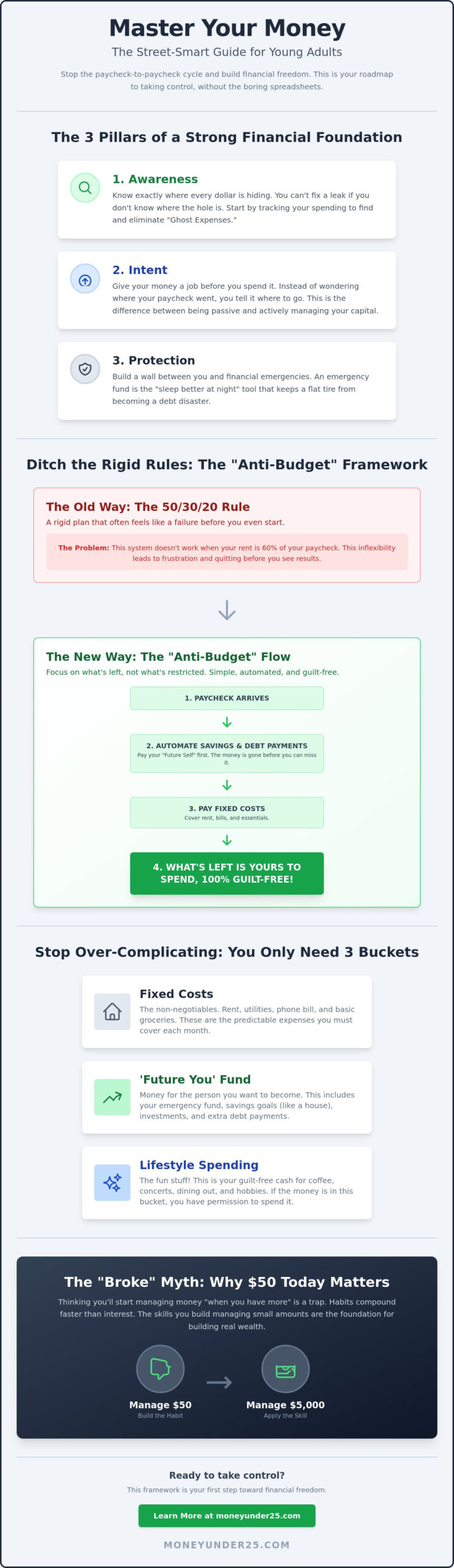
The ‘Broke’ Myth: Why $50 matters as much as $5,000
You might think you’ll start managing your money once you have “real” money. This is a trap. Managing small amounts builds the muscle memory you need for larger salaries later. If you can’t manage $50, you won’t be able to manage $5,000. Mastering finance management for young adults early on means your habits compound faster than your actual interest rates. You have to break the cycle of “I’ll start when I make more.” By the time you make more, your expenses will have grown too. Start with the $50 today.
The 3 Pillars of the Money Under 25 System
To get started, you only need to focus on three specific areas. These are the foundations of everything else we will talk about:
- Awareness: This is about knowing exactly where every dollar is currently hiding. You can’t fix a leak if you don’t know where the hole is.
- Intent: This means giving your money a job before you spend it. Instead of wondering where your paycheck went, you tell it where to go.
- Protection: This is about building a wall between you and financial emergencies. It is the “sleep better at night” fund that keeps a flat tire from becoming a financial disaster.
When you align these three pillars, you stop being a victim of your bank account and start being the boss of it.
The Street-Smart Framework for Managing Your Cash
Most banks and textbooks tell you to follow the 50/30/20 rule. It sounds great on paper. But if your rent takes up 60% of your paycheck because you live in a city with actual jobs, that “rule” just makes you feel like a failure. Real-world finance management for young adults needs to be flexible. Instead of trying to fit into a rigid box, try the “Anti-Budget” approach. You focus on what stays in your account after the essentials are handled. This shift in mindset is a core part of The Importance of Financial Literacy because it keeps you from quitting when the math doesn’t look perfect.
There is a massive difference between tracking and budgeting. Budgeting is making a plan for the future that you might not even keep. Tracking is looking at the cold, hard reality of the past. One is a chore; the other is pure power. When you track your spending, you find “Ghost Expenses.” These are the $15 streaming services you forgot about or the $3 convenience fees that bleed your account dry over a month. Once you see them, you can kill them. This isn’t about being cheap. It is about being intentional with your cash.
Categorizing your world without the headache
Stop over-complicating your categories. You don’t need twenty different folders. You only need three to keep your head above water:
- Fixed costs: These are the non-negotiables. Rent, your phone bill, and basic groceries belong here.
- The ‘Future You’ fund: This is your savings and debt-crushing money. It belongs to the version of you who wants to buy a house or travel next year.
- Lifestyle spending: This is guilt-free cash. Coffee, concerts, and drinks with friends. If the money is in this category, spend it without the stress.
Using tech to do the heavy lifting
Your banking app is either your best friend or your worst enemy. Most modern apps let you set up automated transfers. This is the secret to “hiding” money from yourself. If $50 moves to your savings the second your paycheck hits, you won’t even miss it. You can’t spend what you don’t see. Using simple tools to track your spending without manual data entry makes the whole process effortless. If you are ready to build a system that actually sticks, exploring modern finance management strategies is the fastest way to get ahead of the game.
Managing finances on a ‘Starter’ salary (The #1 Objection)
You probably feel like you don’t have enough money to actually manage. It is the most common excuse in the book. You think, “I’ll start a system when I’m making six figures,” but that is a dangerous trap. Finance management for young adults isn’t about the size of your paycheck. It is about the habits you build while your life is still relatively simple. If you can’t handle a $3,000 monthly income, you will definitely struggle when that number doubles and your responsibilities grow with it.
The secret is the “Pay Yourself First” micro-habit. Even if you can only swing $5 a week, set up an auto-transfer. This isn’t about the $5; it is about proving to yourself that you are a priority. If you wait until the end of the month to see what is left, the answer will always be zero. You also need a plan for irregular income. If you are driving for apps or doing freelance work, don’t just spend that cash as it hits your account. Treat side hustle money as a tactical tool for specific goals, like crushing debt or filling your emergency fund.
When it comes to priorities, you need a simple hierarchy. High-interest debt is a house fire. With the average credit card interest rate sitting at 22.17%, carrying a balance is literally throwing money away. Compare that to the 6.52% rate on federal undergraduate student loans, and you can see where your extra cash should go first. Pay the minimums on everything else, but attack that high-interest debt with everything you have.
The ‘Sleep-at-Night’ Fund: Your first $1,000
A small emergency fund is the ultimate anxiety-killer. It is the difference between a flat tire being a minor annoyance or a total financial disaster. Your first goal is to scrape together $1,000. You can hit the first $500 in 30 days by selling things you don’t use or cutting those “Ghost Expenses” we found during your audit. Put this money in a separate high-yield savings account. Some institutions currently offer up to 5.00% APY, which is significantly better than the 0.62% national average for standard accounts. Keep it out of your main banking app so you aren’t tempted to spend it on a weekend trip.
Frugality vs. Cheapness: Managing your social life
Being smart with money doesn’t mean becoming a hermit. It means practicing value-based spending. Before you buy something, ask: “Will I actually care about this in 48 hours?” If the answer is no, skip it. You can say no to an expensive dinner without losing your friends. Suggest a park hangout or a potluck instead. To make a real dent in your finances, focus on the “Big Three” costs: housing, transport, and food. If you can keep these under control, you don’t have to stress nearly as much about the $6 lattes.
Building a Financial Foundation (Stuff School Skipped)
School taught you that the mitochondria is the powerhouse of the cell, but it probably didn’t mention that your credit score is the powerhouse of your adult life. Most people think credit is just about borrowing money to buy things you can’t afford. That is a dangerous misunderstanding. In reality, your credit score is a “trust score” that future landlords, insurance companies, and even some employers use to see if you are reliable. Mastering the basics of credit is a non-negotiable part of finance management for young adults because it dictates how much your future life will actually cost.
Before you dive in, you need to understand the difference between good debt and bad debt. In a high-interest world, bad debt is anything with an interest rate higher than 10%, like the average credit card offer which currently sits at 22.17%. Good debt is usually tied to something that grows in value or increases your earning potential, like a student loan. However, even “good” debt becomes bad if you don’t have a plan to kill it. To avoid the most common traps, you have to watch out for lifestyle creep, Buy Now Pay Later (BNPL) services that hide the true cost of a purchase, and high-interest car loans that eat your paycheck before you can even drive home.
Credit 101 for the Jobless or Entry-Level
If you don’t have a high income, you can still win the credit game. Start with a secured card or ask a parent with good habits to add you as an authorized user. This builds your history without requiring a massive salary. The most important thing to remember is credit utilization. Credit utilization is the percentage of your total credit limit that you actually use, and keeping this under 30% is the fastest way to boost your score. If you pay your balance in full every month, you are using the bank’s money for free while building a 700+ score.
The Student Loan Survival Strategy
You need to know exactly who you are dealing with. Federal undergraduate loans for the 2026-2027 year carry a fixed rate of 6.52%, while private loans can have much higher, variable rates based on your credit. Don’t just pay the minimums and hope for the best; that is a trap that keeps you in debt for decades. Use the “Avalanche” method to pay off the highest interest rates first to save the most money, or the “Snowball” method to pay the smallest balances first for a quick psychological win. If you want to stop guessing and start growing, it is time to get serious about your finance management strategy.
Your 7-Day Finance Management Kickoff
Information is useless without action. You can read every article on the internet about finance management for young adults, but your bank account won’t change until you move your thumbs. This 7-day kickoff is designed to take you from confused to in control without burning you out. We aren’t aiming for perfection here. We are aiming for a system that actually works in the real world.
- Day 1-2: The Audit. You can’t manage what you don’t see. Log into every banking app, credit card portal, and payment app like Venmo or CashApp. List every recurring charge. You will likely find at least two subscriptions you forgot existed. Kill them immediately.
- Day 3-4: The Goal-Setting. Why are you doing this? If your only goal is “to have more money,” you will fail. Be specific. Do you want a reliable car, a trip to Japan, or just the freedom to quit a job you hate? Write down three concrete goals and what they cost.
- Day 5: The Automation. This is the most important day. Set up your “Future You” transfers. Even if it is just $10 going into a high-yield savings account, automate it. If you wait until you feel like saving, it won’t happen.
- Day 6-7: The Review. Look at your plan and adjust for reality. If you realized your rent is higher than you thought, tweak your lifestyle spending. This is a living system, not a set of stone tablets.
Action Step: The 24-Hour Spending Freeze
Impulse buys are the silent killers of your financial foundation. To combat this, implement a strict 24-hour rule for anything that isn’t a basic necessity. If you see a pair of shoes or a new gadget you “need,” put it on a digital “Wants” list and walk away. Most of the time, the dopamine hit fades and you’ll realize you don’t actually want the item. This habit helps you identify your spending triggers. Are you buying things because you’re stressed, bored, or because an Instagram ad caught you at a weak moment? Identifying these patterns is a massive win for your long-term success.
Next Steps with Money Under 25
You don’t have to do this alone. Finance management is a team sport, and our tools are built to help you track your progress without the headache of manual data entry. By joining a community of peers who are also navigating the same hurdles, you turn a stressful chore into a tactical advantage. If you are ready to dive deeper into the specifics of making your cash flow work, check out our ‘Budgeting for Young Adults’ guide next! It is the logical next step in your journey toward total financial freedom.
Take Back Control of Your Bank Account
You now have the framework to stop guessing where your money goes and start telling it where to stay. By auditing your subscriptions, setting up that “Future You” automation, and mastering the basics of credit, you are already ahead of the curve. Real-world finance management for young adults isn’t about being perfect. It’s about being consistent. Even if you’re starting on a starter salary, these small shifts build the foundation for a life where you aren’t constantly refreshing your banking app in a panic.
Founded by Simon David in 2026, Money Under 25 was built to fill the gaps left by traditional education. We provide specialized tools and relatable, peer-to-peer guidance designed specifically for the hurdles you face today. You don’t need a degree in economics to win at this game; you just need the right system. Start managing your future today with Money Under 25 and join a community that actually gets it. You’ve done the hard part by starting. Keep that momentum going and build the freedom you deserve.
Frequently Asked Questions
How much money should a 20-year-old have in savings?
There is no magic number that fits everyone, but your first major milestone should be a $1,000 emergency fund. This amount covers most common setbacks like a flat tire or a surprise medical co-pay. Once that is secure, aim to save enough to cover three months of your basic living expenses. Don’t stress if you are starting from zero. The habit of saving consistently is much more important than the initial balance.
Can I manage my finances if I’m living paycheck to paycheck?
You definitely can, and this is actually the most important time to start. Effective finance management for young adults is about gaining control over the money you already have, regardless of the amount. Start by tracking every single cent for 30 days to find “Ghost Expenses” like forgotten apps. Reclaiming even $20 a month gives you a small victory and proves you can direct your cash instead of just watching it disappear.
What is the best way to start building credit under 25?
The most reliable way to start is by opening a secured credit card or becoming an authorized user on a parent’s established account. These methods are perfect for students or entry-level workers because they don’t always require a high income to get started. The key is to pay your balance in full every single month without exception. Keeping your credit utilization low is the fastest way to build a score that landlords will trust.
Is the 50/30/20 rule actually realistic for students?
Honestly, it is often unrealistic if you live in a city with high rent. For many students, essentials like housing and groceries might eat up 70% of their income. Instead of forcing a rule that doesn’t fit your life, try the “Anti-Budget” approach. Focus on covering your non-negotiables first, then set aside a tiny amount for your “Future You” fund. Whatever is left over becomes your guilt-free spending money for the week.
How do I manage my money if I have an irregular income?
You should build your baseline budget on your “floor” income, which is the minimum amount you expect to make in a slow month. When you have a high-earning month from side hustles or extra shifts, treat that extra cash as a tactical bonus. Use it to pad your emergency fund or pay down debt faster. This strategy creates a financial buffer so you aren’t scrambling to pay rent when the work slows down.
Should I prioritize paying off student loans or saving for emergencies?
You should almost always prioritize your emergency fund first. Having $1,000 in the bank acts as a shield that prevents you from reaching for high-interest credit cards when life goes sideways. Federal student loans often have lower interest rates and flexible repayment options compared to other types of debt. Once your basic emergency fund is set, you can then focus on aggressively attacking the principal on your loans to save on interest.
What are the most common financial mistakes young adults make?
The biggest traps are lifestyle creep and using “Buy Now, Pay Later” services for things you don’t need. It’s tempting to spend more the second you get a raise, but that keeps you trapped in the paycheck to paycheck cycle. Another error is waiting too long to begin finance management for young adults because you think you’re “too broke” to care. Starting small now is what prevents major financial disasters later in your 20s.
How can I save money on a very small salary?
Focus on the “Big Three” expenses: housing, transport, and food. Small changes like living with roommates or meal prepping save significantly more than cutting out your morning coffee. Set up an automated transfer to “hide” $5 or $10 from yourself every payday. If the money never hits your main checking account, you won’t be tempted to spend it. These micro-savings add up much faster than most people realize.





Pingback: Financial Wellness for Young Adults: Less Stress, More Cash in 2026