The Short Answer
Best first move: put $100 into a Roth IRA and buy a total market index fund.
If you don’t qualify for a Roth IRA: open a taxable brokerage at Fidelity or Schwab and do the same.
What to buy: VTI (Vanguard Total Market ETF) or FSKAX (Fidelity Total Market Index) — both have 0% minimum.
What not to do: don’t buy individual stocks, crypto, or penny stocks with your first $100.
The most important thing: starting with $100 at 20 beats starting with $10,000 at 35.
$100 feels too small to matter. It isn’t.
$100 invested at 20 in a total market index fund becomes approximately $2,100 by age 65 at an 8% average annual return. That same $100 invested at 35 becomes $680. The difference isn’t the amount — it’s the time. Starting now with $100 is more powerful than starting later with $1,000.
This guide covers exactly what to do with your first $100 — the account to open, what to actually buy, and the things to avoid that will cost you money instead of making it. If you haven’t yet built your emergency fund or know what to do after your emergency fund, read those first. Investing before your emergency fund is in place is the wrong order.
Before You Invest $100 — A Quick Checklist
Investing the right $100 matters. Investing the wrong $100 — money you need in 6 months, or money that should pay down 20% APR credit card debt — costs you money.
| # | Check | If no — do this first |
| 1 | Do you have a $500+ emergency fund? | Build that first. Emergency fund before investing. |
| 2 | Are you free of credit card debt above 15% APR? | Pay that off first. 20% APR debt beats any investment return. |
| 3 | Is this money you won’t need for at least 5 years? | If you need it in under 5 years, keep it in a HYSA — not stocks. |
| 4 | Do you have a stable income covering your monthly bills? | Investing while behind on rent creates a worse problem. |
| 5 | Are you investing for the long term (not to get rich quickly)? | If you want fast money, investing isn’t the tool. This is a 10-40 year strategy. |
If you checked all five: you’re ready. Your $100 should be invested, not sitting in a checking account.
Where to Put Your First $100
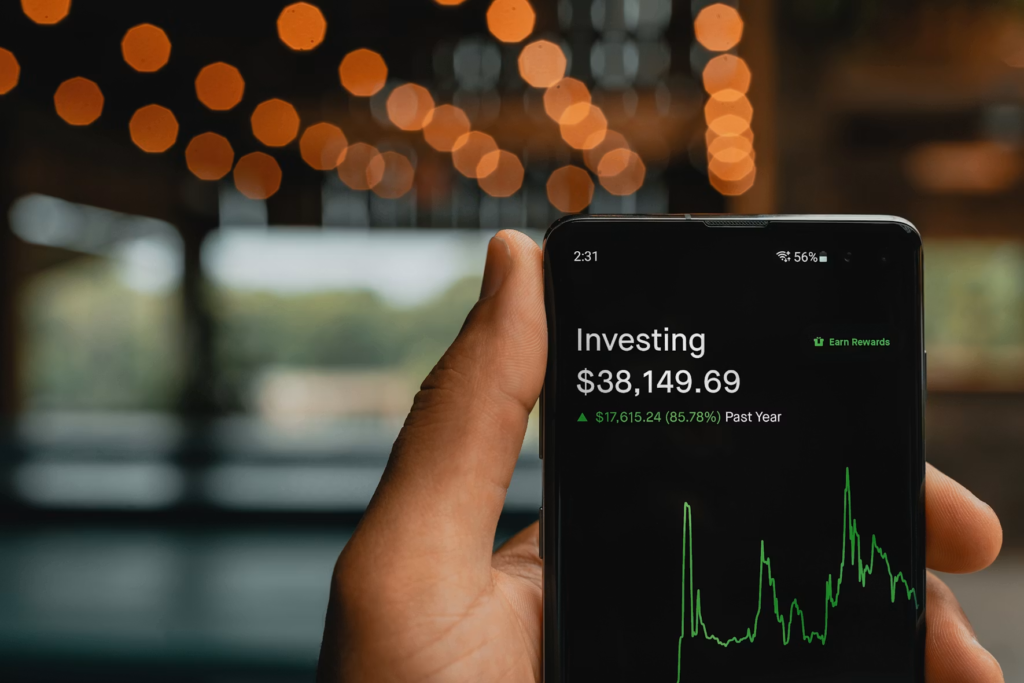
Option 1: A Roth IRA (Best for Most 18-25 Year Olds)
A Roth IRA is the most powerful investment account for young adults. You contribute after-tax dollars, the money grows tax-free, and withdrawals in retirement are also tax-free. According to the IRS, the 2026 contribution limit is $7,000/year. Your first $100 goes here before anywhere else.
Why Roth IRA beats a regular brokerage account for beginners: Taxes. In a regular brokerage account, you pay taxes on dividends and capital gains each year plus taxes when you sell. In a Roth IRA, none of that happens. On a 40-year investment horizon, the tax difference compounds into tens of thousands of dollars.
Where to open one: Fidelity, Vanguard, or Charles Schwab. All three have $0 account minimums and allow you to invest in index funds with no transaction fees. Opening takes 15 minutes online.
Income requirement: You need earned income (wages, salary, self-employment) to contribute to a Roth IRA. The amount you can contribute is limited to your earned income for the year if it’s under $7,000. If you earned $2,000 this year, you can contribute up to $2,000.
If your income is too low to open a Roth IRA this year, or you haven’t earned any income, open a regular taxable brokerage account at Fidelity or Schwab instead. Same investments, just without the tax benefits. You can open a Roth IRA next year when you have earned income.
Option 2: A Taxable Brokerage Account
If you don’t qualify for a Roth IRA or have already maxed your contribution, a taxable brokerage account is the next step. Fidelity, Schwab, and Vanguard all offer these with $0 minimums.
The difference from a Roth IRA: you’ll owe taxes on dividends each year and on any gains when you sell. For long-term investing (10+ years), this is manageable. For shorter-term goals, a HYSA is usually better.
Option 3: Your Employer’s 401k (If Available)
If your employer offers a 401k with a match, contribute enough to get the full match before anything else — including a Roth IRA. A 50% or 100% employer match is a guaranteed return no investment can beat. After the match, go to the Roth IRA.
What to Actually Buy With Your $100

Most beginner investors make the same mistake: trying to pick winning stocks. This is the wrong approach. The evidence from decades of market research is clear: most individual stock pickers underperform a simple index fund over any 20-year period.
According to SEC Investor.gov, index funds — which buy a small slice of every company in an index like the S&P 500 — provide built-in diversification and historically match market returns. The best first investment for almost every beginner is a total market index fund.
| Fund | What it tracks | Expense ratio | Minimum | Available at |
| VTI | Total US market | 0.03% | $1 | Any brokerage |
| FSKAX | Total US market | 0.015% | $1 | Fidelity |
| VOO | S&P 500 | 0.03% | $1 | Any brokerage |
| SWTSX | Total US market | 0.03% | $1 | Schwab |
| FZROX | Total US market | 0.00% | $1 | Fidelity only |
The expense ratio matters: A 0.03% expense ratio means you pay $0.03 per year for every $100 invested. A 1% expense ratio means $1 per year. Over 30 years on a growing portfolio, a 1% fee costs tens of thousands of dollars more than a 0.03% fee. Always check the expense ratio before buying any fund.
If you open a Fidelity account, FZROX has a 0.00% expense ratio — no fees at all. It’s one of the only truly free index funds in existence. It’s only available through Fidelity, which is one strong reason to start there.
What $100 Becomes — The Compound Interest Reality
This is why starting at 20 with $100 matters more than waiting until 30 with $1,000:
| You invest $100 at age | At age 45 | At age 55 | At age 65 | Years invested |
| Age 18 | $685 | $1,480 | $3,192 | 47 years |
| Age 20 | $584 | $1,261 | $2,720 | 45 years |
| Age 25 | $432 | $933 | $2,014 | 40 years |
| Age 30 | $320 | $691 | $1,492 | 35 years |
| Age 35 | $237 | $512 | $1,105 | 30 years |
Assumes 8% average annual return (historical S&P 500 average after inflation is approximately 7-8%). Past performance does not guarantee future results.
The difference between investing at 20 versus 35: $2,720 versus $1,105 from the same $100. That gap is purely time. Every year you wait costs you money — not because you spent it, but because you didn’t let it compound.
What Not to Do With Your First $100

The investment world is full of things designed to take money from beginners. These are the most common mistakes with first investments:
Individual Stocks
Picking individual stocks requires time, research, and expertise that most professional fund managers don’t consistently have. According to FINRA, the majority of actively managed funds underperform their benchmark index over any 15-year period. A first-time investor with $100 has lower odds than those professionals. Start with index funds.
Cryptocurrency
Crypto can go up 500% and down 80% in the same year. For a first investment of $100 from someone building their financial foundation, this volatility is inappropriate. Crypto is speculative. Index funds are investment. These are different things for different purposes.
Penny Stocks
Stocks trading under $5 are cheap for a reason — they’re usually companies with serious problems. They’re also highly susceptible to manipulation. The pattern: someone accumulates a large position, promotes the stock online to attract buyers, then sells at the peak while new buyers lose money. This is called a pump-and-dump scheme.
High-Fee Investment Products
Some investment apps, financial advisors, and products charge 0.5-2% annual fees. At 2% annual fees, you give up more than a third of your long-term returns compared to a 0.03% index fund. Always check the expense ratio and any advisory fees before investing anywhere.
If an investment promises guaranteed returns, unusually high returns (15%+ annually), or ‘risk-free’ money — it is a scam. There are no guaranteed returns in investing. High promised returns always mean high risk or fraud.
Which App to Use for Your First $100
| App/Platform | Account min. | Fees | Roth IRA? | Best for |
| Fidelity | $0 | $0 | Yes ✅ | Best all-around. Free index funds (FZROX 0.00%). Best for beginners. |
| Schwab | $0 | $0 | Yes ✅ | Strong option. Good education resources for beginners. |
| Vanguard | $0 | $0 | Yes ✅ | Good. UI less friendly than Fidelity but strong reputation. |
| Robinhood | $0 | $0 | Yes ✅ | Easier app but encourages frequent trading. Better for later stages. |
| Acorns | $0 | $3/mo | Yes ✅ | Round-up investing. $3/month fee is high on small balances — avoid until $1,000+. |
For a detailed comparison of Robinhood and Acorns specifically — two of the most popular apps for young investors — see Robinhood vs Acorns. They work very differently and suit different investing styles.
Your First 3 Steps — Do These This Week

- Open a Fidelity account online (15 minutes). Go to fidelity.com. Click “Open an Account.” Choose either a Roth IRA (if you have earned income this year) or a taxable brokerage account. Enter your personal information and link your bank account.
- Transfer $100. Once the account is open, initiate a transfer from your linked bank account. It takes 1-3 business days to settle.
- Buy FZROX or VTI. Once the money settles, search for FZROX (if at Fidelity) or VTI (at any brokerage). Click “Buy.” Enter $100. Choose “Market order.” Confirm. You now own a tiny piece of thousands of US companies.
That’s it. The hardest part of investing is starting. Once you’ve done it once, adding to it is straightforward. Set up a recurring automatic investment of $25-50/month and the habit runs without requiring a decision each time.
FAQs
Is $100 enough to start investing?
Yes. Most major brokerages — Fidelity, Schwab, Vanguard — have $0 account minimums and allow you to buy fractional shares of index funds with as little as $1. $100 is enough to own a piece of thousands of companies through a total market index fund. The amount matters less than the habit. Someone who invests $100/month consistently from age 20 to 65 accumulates significantly more than someone who waits until 35 to invest $500/month.
What should a beginner invest $100 in?
A total market index fund — VTI at any brokerage, FZROX at Fidelity (free), or SWTSX at Schwab. These funds buy a small slice of every publicly traded US company, giving you instant diversification at an extremely low cost. According to SEC Investor.gov, diversification is one of the most effective strategies for managing investment risk — and index funds provide it automatically.
Should I use Robinhood or Acorns for my first $100?
Neither is the best choice for a first $100. Acorns charges $3/month — that’s 36% annually on a $100 balance, which wipes out any investment gains. Robinhood has no such fee issue but its design encourages frequent trading, which hurts long-term returns. For a first investment, Fidelity or Schwab give you better tools, better education, and a Roth IRA option. Once your balance grows, Robinhood vs Acorns compares Robinhood and Acorns in detail.
Is investing $100 worth it?
The $100 itself may not change your life. The habit it starts will. Consistent small investments over decades build real wealth — not from any single $100, but from the compounding that happens when $100 becomes $150 becomes $200 becomes a portfolio that grows every year. The earliest $100 you invest will be worth more than any $100 invested later, because it has the most time to compound.
Should I pay off debt or invest first?
It depends on the interest rate. Credit card debt above 15% APR — pay that off first, always. Student loans or car loans below 7% — you can invest while making normal payments because historical stock returns (7-10%) likely beat the loan interest cost. For the full decision framework on the order of operations between debt and investing, what to do after your emergency fund covers it step by step.
The Bottom Line
Your first investment doesn’t need to be complicated. Open a Fidelity account. Open a Roth IRA if you have earned income. Buy FZROX or VTI with your $100. Set up a $25/month automatic investment. Done.
The only mistake with $100 is not investing it. The market’s long-term direction is up. Every year you wait costs you compounding time you can’t get back.
The next steps after your first investment: make sure your emergency fund is in place at a high-yield savings account, then review your financial goals for your 20s to see where investing fits in your overall financial picture. The investing habit you’re building now is the most financially impactful thing you can do in your 20s.
Sources
1. SEC Investor.gov — index funds and diversification
2. IRS — Roth IRA rules and contribution limits
3. FINRA — investor education and active vs passive management
4. Consumer Financial Protection Bureau — money and investing basics