Quick Answer
To save $5,000 in 6 months, you need to save $834 per month — about $209 per week.
That requires a take-home income of at least $2,800/month if saving 30%, or $1,700/month if you combine saving with a small income boost.
The two fastest levers: automate the transfer on payday and cut your single biggest spending category first.
Keep the money in a high-yield savings account (4-5% APY) — not your regular checking account.
Most people hit this goal faster than expected once the first $1,000 is in place.
$5,000 in six months is a specific, achievable goal — and the math is simpler than most people expect. At $834 per month, it works out to $209 per week or $30 per day. The question is not whether the number is possible. The question is which combination of spending cuts and income increases gets you there fastest.
This guide gives you the exact month-by-month plan, income-based savings targets, and the specific moves that make the biggest difference. It is built around real spending data from the Bureau of Labor Statistics and structured for people who have never saved this much before.
One thing to know before starting: where you keep this money matters almost as much as how much you save. Best high-yield savings accounts currently pay 4-5% APY — meaning $5,000 earns roughly $100-125 in interest over six months, completely passively. A regular checking account pays nearly nothing.
The Math: What $5,000 in 6 Months Actually Requires
Before building a plan, know exactly what you are working toward:
| Timeframe | Required savings | Per week | Per day |
| 6 months (goal) | $834/month | $209/week | $30/day |
| 5 months (faster) | $1,000/month | $250/week | $36/day |
| 8 months (slower) | $625/month | $156/week | $22/day |
| 12 months | $417/month | $104/week | $15/day |
The six-month timeline at $834/month is realistic for most people earning $2,500+/month in take-home pay — that is a 33% savings rate. For lower incomes, a combination of spending cuts and a small side income can close the gap without requiring a 33% cut from a tight budget.
Can You Save $5,000 in 6 Months? Income-Based Reality Check
Whether this goal is achievable depends directly on your income and current expenses. Here is an honest breakdown:
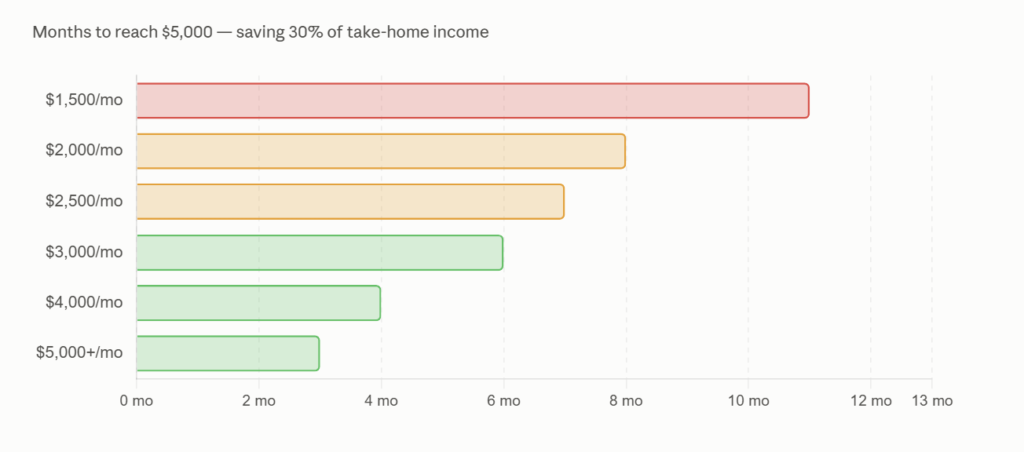
| Take-home/mo | 25% savings | 30% savings | Months to $5K | Verdict |
| $1,500 | $375 | $450 | 11-13 months | Add income |
| $2,000 | $500 | $600 | 8-10 months | Cut + hustle |
| $2,500 | $625 | $750 | 7-8 months | Achievable |
| $3,000 | $750 | $900 | 6 months | On target ✅ |
| $4,000 | $1,000 | $1,200 | 4-5 months | Faster ✅ |
| $5,000+ | $1,250+ | $1,500+ | 3-4 months | Very fast ✅ |
If your take-home is under $2,000/month: the 6-month timeline is tight but not impossible. The fastest path is combining $400-500/month in savings cuts with $300-400/month in extra income from a side hustle. Do not try to cut $834 from a $2,000 budget — add income instead.
If the six-month timeline feels too aggressive for your income, the 3-month $1,000 savings plan is a better starting point — build the habit first, then scale up.
The Month-by-Month $5,000 Savings Plan
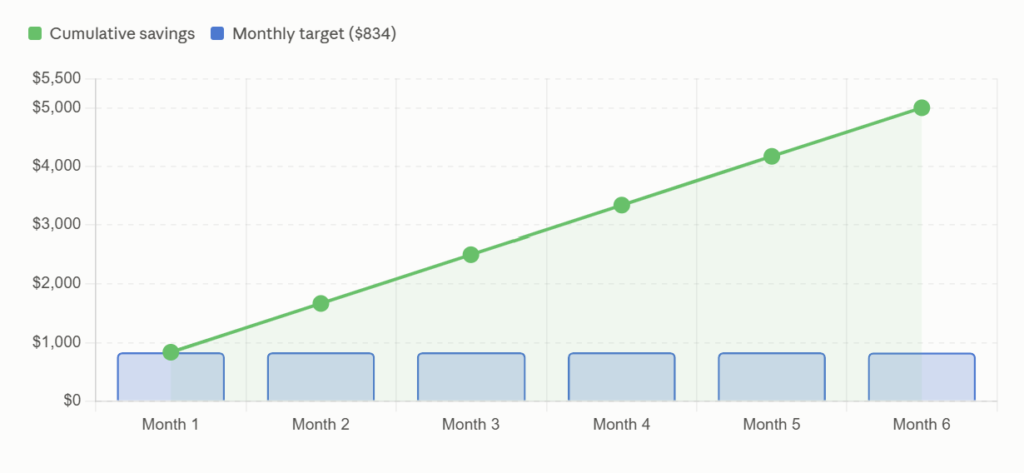
| Month | Target saved | Running total | Main focus | Milestone |
| Month 1 | $834 | $834 | Setup: open HYSA, automate transfer, run spending audit | First $834 |
| Month 2 | $834 | $1,668 | Cut biggest spending leak (food delivery, subscriptions, impulse) | $1,500+ |
| Month 3 | $834 | $2,502 | Halfway check. If on track — keep going. If behind — add income. | Halfway ✅ |
| Month 4 | $834 | $3,336 | Review budget again. Kill any remaining waste. Interest growing. | $3,000+ |
| Month 5 | $834 | $4,170 | End is visible. Momentum is high. Do not touch the account. | $4,000+ |
| Month 6 | $830 | $5,000 | Goal reached. Decide what $5,000 is for. | Done ✅ |
Month 3 is the most important checkpoint. If you are more than $200 behind at the halfway mark, add one income source rather than cutting more from the budget. Trying to cut $200 more per month from an already-tight budget is harder than earning an extra $50/week delivering food on weekends.
The Two Levers That Make the Biggest Difference
Most savings advice lists 50 things to cut. In practice, two things move the needle most:
Lever 1: Automate on Payday
Set up an automatic transfer from checking to your high-yield savings account for the day your paycheck arrives — before you see the money in checking. On a $3,000/month income with a $834 target, set the transfer for $417 every two weeks on biweekly payday.
The research on this is consistent: people who automate savings save 2-3x more than those who try to save from what is left over at month end. There is never anything left over. Automate first.
The Consumer Financial Protection Bureau consistently identifies automated saving as the single most effective behavioral change for people building savings for the first time.
Lever 2: Cut Your Single Biggest Spending Category
According to Bureau of Labor Statistics Consumer Expenditure data, the top three spending categories for adults under 35 are housing, food, and transportation. Housing is usually fixed. That leaves food and transport as the targets.
For most young adults, food delivery is the single biggest controllable spending leak — averaging $150-250/month in apps alone. Eliminating or significantly cutting food delivery and meal prepping 4-5 days per week frees up $100-200/month. Combined with automating savings, most people cover 60-80% of their monthly target from these two changes alone.
For a complete list of high-impact cuts, save money fast covers 23 specific moves ranked by how much they typically free up per month.
Your $5,000 Savings Plan Based on What You Can Save Per Month
If $834/month is not realistic right now, here is what different monthly savings amounts actually produce:
| Monthly savings | 3 months | 6 months | 9 months | 12 months |
| $300/month | $900 | $1,800 | $2,700 | $3,600 |
| $417/month | $1,251 | $2,502 | $3,753 | $5,004 ✅ |
| $500/month | $1,500 | $3,000 | $4,500 | $6,000 |
| $625/month | $1,875 | $3,750 | $5,625 ✅ | $7,500 |
| $834/month | $2,502 | $5,000 ✅ | $7,506 | $10,008 |
| $1,000/month | $3,000 | $6,000 | $9,000 | $12,000 |
These are contribution totals only — your actual balance will be slightly higher due to interest in a high-yield savings account. At 4.5% APY, $834/month over 6 months produces approximately $5,060-5,080 including interest.
What Is $5,000 Actually For? Setting the Right Goal
The purpose of your $5,000 shapes where you keep it and how aggressive your timeline should be:
| Purpose | Where to keep it | Notes |
| Emergency fund | High-yield savings account | $5,000 covers 2-3 months of expenses for most people. Keep accessible. |
| Apartment deposit + setup | High-yield savings account | Most security deposits are 1-2 months rent. $5,000 covers deposit + first month + setup costs. |
| Car purchase (cash) | High-yield savings account | A reliable used car for $4,000-6,000 is realistic in most US markets. |
| Travel fund | High-yield savings account | $5,000 covers most domestic trips or a budget international trip with flights. |
| Debt payoff fund | Pay directly to debt | If paying off high-interest debt, do not hold in savings — pay it off faster. |
| Investment seed | Roth IRA or brokerage | $5,000 seeds a Roth IRA for the year. Better long-term than cash savings. |
If $5,000 represents your emergency fund, check how that compares to what you should have saved by 25 — $5,000 is at or above the median for Americans under 35 according to Federal Reserve data.
Why Most People Fail to Save $5,000 in 6 Months
| Mistake | What to do instead |
| Keeping savings in checking account | Open a separate high-yield savings account. Out of sight, out of mind — and earning 4-5% instead of 0.01%. |
| Waiting to save what is left over | Automate on payday. Transfer first, budget the rest. |
| Trying to cut 50 small things | Cut one big thing first (food delivery, subscriptions, car expenses). Big wins are faster than many small ones. |
| Dipping into the account mid-month | Keep savings at a different bank — adds friction. Set a rule: touching savings before month 6 means starting over. |
| Not tracking progress weekly | Check your savings balance every Sunday. 5 minutes. Seeing the number grow is motivating. |
| Setting too aggressive a timeline for current income | If $834/month is not realistic, adjust the timeline. A 9-month plan you finish beats a 6-month plan you abandon. |
How to Save $5,000 Faster — Income Side
Spending cuts have a floor — you cannot cut below your essential expenses. Income has no ceiling. Here are realistic income additions that can speed up the timeline:
| Income source | Monthly add | How it shortens the timeline |
| Food delivery (8-10 peak hours/week) | +$300-400 | Brings total savings to $1,100-1,200/month — reaches $5,000 in about 4-5 months |
| Sell unused items (month 1 only) | +$200-500 | One-time boost. Most homes have $300-500 in unused electronics, clothes, and books. |
| Tutoring (2-3 hours/week) | +$150-300 | $25-40/hour depending on subject. Fully flexible schedule. |
| Freelance writing or design | +$200-600 | Variable but highest hourly rate. First clients take 2-3 weeks to find. |
| TaskRabbit / odd jobs | +$200-400 | $25-50/hour for furniture assembly, moving help, cleaning. |
Adding even one income source of $200-300/month on top of your regular savings cuts the $5,000 timeline from 6 months to 4-5 months. For other income options, the $500/month savings guide includes side income strategies that work alongside a regular job.
Where to Keep Your $5,000 While You Save It
Savings for a 6-month goal belong in a high-yield savings account (HYSA), not a regular checking account and not the stock market. The FDIC insures HYSA accounts up to $250,000, so the money is safe. Current rates of 4-5% APY on $5,000 earn approximately $100-125 in interest over 6 months — not life-changing, but it is money for doing nothing.
What to look for in an HYSA for this goal:
- No minimum balance requirement — many people start this goal at $0
- No monthly fees — fees eat into savings
- APY of 4%+ — most major online banks currently qualify
- Easy transfer to checking — for when the goal is reached and you need the money
- Not linked to your regular debit card — access friction prevents impulse withdrawals
Current top options are covered in best high-yield savings accounts — updated monthly as rates change.
FAQs
How much do I need to save per month to have $5,000 in 6 months?
You need to save $834 per month to reach $5,000 in exactly 6 months. That works out to $209 per week or approximately $30 per day. In a high-yield savings account at 4-5% APY, you will earn an additional $60-100 in interest, bringing your total slightly above $5,000 at the 6-month mark. If $834/month is more than your budget allows, extend the timeline: at $625/month you reach $5,000 in 8 months; at $417/month it takes 12 months.
Is saving $5,000 in 6 months realistic?
Yes, for people earning $2,800+ per month in take-home pay, $5,000 in 6 months is realistic at a 30% savings rate. For lower incomes, combining $400-500/month in spending cuts with $200-300/month in extra income can close the gap. The key variables are your fixed expenses (rent, car payment, loans) and your variable spending (food, subscriptions, entertainment). According to the Bureau of Labor Statistics, discretionary spending for young adults averages $500-800/month — meaning there is often $200-400 in savings available before needing to change income.
What is the best way to save $5,000 fast?
The fastest combination: (1) automate a transfer of $834 to a high-yield savings account on payday, (2) cut food delivery and reduce dining out by $150-200/month, (3) sell unused items for a one-time $200-400 boost in month 1, (4) add one income source of $200-300/month if spending cuts alone are not enough. Most people who follow all four steps reach $5,000 in 4-5 months rather than 6. For a full list of high-impact spending cuts, see save money fast.
Can I save $5,000 in 6 months on a low income?
On a take-home of under $2,000/month, saving $834/month (42% of income) is very difficult from cuts alone. The more realistic approach: aim for $400-500/month in savings from spending cuts, and add $300-400/month from a flexible income source like food delivery or tutoring. This brings you to $5,000 in 7-8 months rather than 6. If you are starting from zero, saving $1,000 in 3 months first builds the habit and proves the system works before scaling up.
How do I save $5,000 if I live paycheck to paycheck?
Living paycheck to paycheck means your income and expenses are almost equal — so adding savings requires either increasing income or decreasing expenses. Start with the spending audit: go through the last 3 months of bank statements and identify your five largest non-housing expenses. Most people find $100-200/month in genuinely painless cuts (subscriptions they forgot about, food delivery they use out of habit, impulse purchases). Then stop overspending covers the behavioral side — why overspending happens and the systems that stop it.
Where should I keep my $5,000 while I save it?
A high-yield savings account (HYSA) is the right place for a 6-month savings goal. It is FDIC-insured (safe), earns 4-5% APY (more than regular savings), and is accessible when the goal is complete. Keep it at a different bank from your regular checking — the transfer friction prevents impulse spending of the savings. Do not invest it in stocks for a 6-month goal: the market can drop 10-20% in that timeframe and you may need the money before it recovers. See best high-yield savings accounts for current rates.
What should I do with $5,000 once I have saved it?
It depends on what the $5,000 is for. If it is your emergency fund, keep it in the HYSA and start directing new savings toward a Roth IRA or other investment account — see how much you should have saved by 25 for context on how $5,000 compares to typical savings at your age. If it is for a specific goal (apartment deposit, car, travel), use it for that goal and immediately restart a smaller recurring savings habit. The goal completion itself is valuable: most people find the second $5,000 much easier to save than the first.
How much do I need to save per week to reach $5,000 in 6 months?
To save $5,000 in 6 months (approximately 26 weeks), you need to save $192-209 per week depending on how you count the months. At $209 per week on biweekly pay, set your automatic transfer at $418 every two weeks. Round up to $420 to create a small buffer — anything above $5,000 at the end goes toward your next goal.
Sources
1. Bureau of Labor Statistics — Consumer Expenditure Survey, spending data by age
2. Consumer Financial Protection Bureau — savings behavior and automated savings research
3. Federal Reserve — household savings data and financial well-being reports
4. FDIC — high-yield savings account deposit insurance guidelines
The Bottom Line
$5,000 in 6 months requires $834/month — and two things make or break whether you get there: automating the transfer on payday, and cutting your single biggest discretionary spending category.
The six-month timeline is realistic for take-home incomes of $2,500+. Below that, either extend the timeline or add a small income source. The math is simple. The budget setup takes 30 minutes. The account setup takes 10 minutes. The hard part is not touching the money once it is there.
Once you hit $5,000, the next question is what to do with it — and that depends on whether this is your emergency fund, a specific goal, or seed money for investing. The $2,000 in 3 months plan and the $8,000 in 3 months guide give you the framework for different savings targets, so you can keep the momentum going once this goal is done.