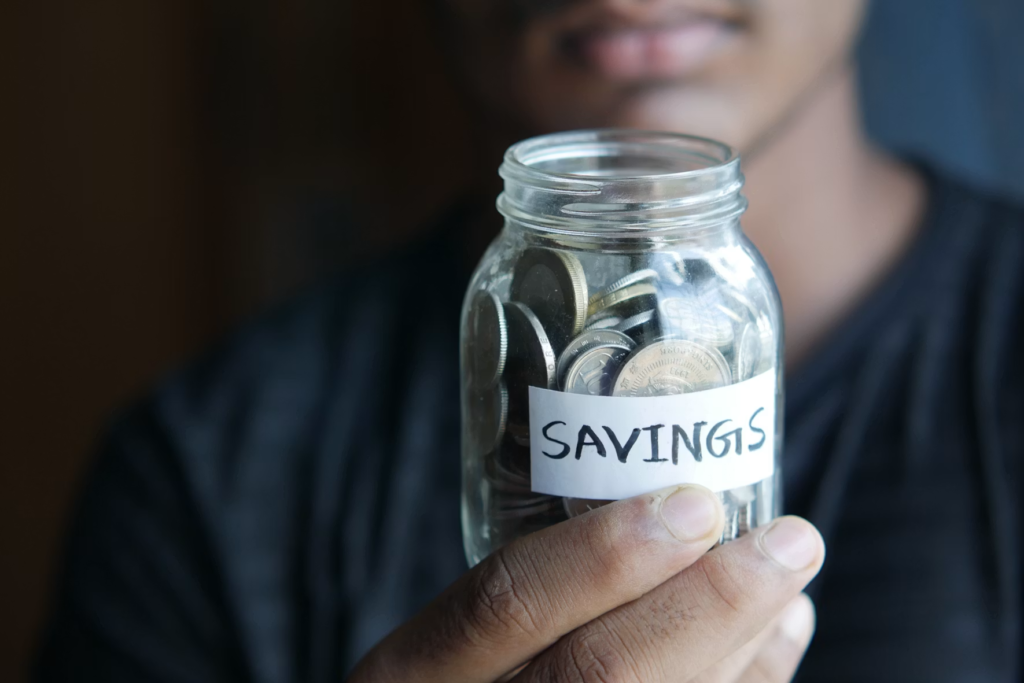
The Math — Right Up Front
$5000 ÷ 6 months = $833/month = $208/week = $29.75/day.
That’s the number. Everything else in this guide is how to find it.
If $833/month sounds impossible: the plan below shows how to build to it in stages.
If you can do $500/month: you hit $5000 in 10 months. Still achievable.
Open a separate high-yield savings account before you start — keep this money invisible.
$5000 in 6 months is a specific, achievable goal for most people earning $30,000 or more annually — but only if you treat it like a non-negotiable bill payment, not a “whatever’s left over” target.
According to the Bureau of Labor Statistics, the average American spends approximately $3,800/month on living expenses. On a $45,000 salary (take-home approximately $3,100-3,400/month), saving $833/month requires significant cuts or additional income. On a $60,000 salary (take-home approximately $3,800-4,100/month), it’s tight but achievable without extra income.
This guide gives you the exact week-by-week calendar, three income scenarios, where to find the money, and what to do when you hit month 2 and motivation drops. For the shorter version of this plan — how to save $1,000 in 3 months in 3 months — that guide covers the fastest approach.
The Math — Three Income Scenarios
$833/month is a fixed target. What changes is how hard it is to find based on your income:
| Annual salary | Monthly take-home | Save $833/month | Reality check |
| $30,000 | ~$2,100 | 40% of income | Very hard. Requires either extra income OR lower living costs (roommates, no car). Extend to 10 months at $500/month. |
| $40,000 | ~$2,750 | 30% of income | Challenging but doable with strict budgeting. No dining out, minimal subscriptions. May need 1 side hustle weekend. |
| $50,000 | ~$3,350 | 25% of income | Achievable with discipline. Clear the $833 first on payday, live on the rest. |
| $65,000+ | ~$4,100+ | 20% of income | Straightforward if spending is managed. 20% savings rate is a strong habit to build. |
If saving $833/month would require you to skip rent, utilities, or minimum debt payments — don’t. Modify the target. Save $400/month for 13 months, or $600/month for 9 months. Getting to $5,000 in 9 months is far better than failing the 6-month plan in week 3.
Before Week 1: The Setup That Makes or Breaks the Plan
Most people who fail a savings plan fail before they make a single transfer. The setup is more important than motivation.
Open a Separate High-Yield Savings Account
The $5,000 cannot be in your checking account. Money that’s visible gets spent. Open a dedicated high-yield savings account at a different bank from your checking account (Ally, SoFi, Marcus) and name it “$5K Goal” or similar. Transfer the $833 the day you get paid — before you see it.
According to the FDIC, high-yield savings accounts at online banks are fully insured and currently pay 4-5% APY. At 4.5% APY, your $5,000 savings plan earns approximately $112 in interest — your money working while you save.
Set Up Automatic Transfer
Automation is the entire plan. Log into your checking account and set up an automatic transfer of $833 (or your modified target) to go out on your payday date. Monthly if paid monthly, biweekly if paid biweekly ($416.50 each paycheck).
The transfer happens before you decide whether to save this month. The decision is made once — not 26 times.
Do a Budget Audit Before Day 1
Before starting, spend 30 minutes reviewing your last 3 months of bank statements. List every subscription and recurring charge. build a budget shows the exact process. You’re looking for at least $200-300 in spending that can be cut immediately — this becomes part of your $833.
The 26-Week Calendar
Here’s exactly what to focus on each phase of the 6-month plan:
| Weeks | Savings balance | Monthly saved | Focus for this phase |
| 1-2 | $0 → $416 | $833 | Hardest weeks. New habit forming. Cancel 3 subscriptions. Pack lunch every day. Expect discomfort. |
| 3-4 | $416 → $833 | $833 | Month 1 end. Most people quit here. Don’t check the balance obsessively. The habit is forming. |
| 5-6 | $833 → $1,250 | $833 | First milestone crossed. Spending habits are adjusting. Find one new income source if needed. |
| 7-8 | $1,250 → $1,666 | $833 | Approaching $2,000. Motivation is back. Put any windfall directly into this account. |
| 9-10 | $1,666 → $2,083 | $833 | Past the halfway point. Review: what cuts stuck? What didn’t? Adjust the budget. |
| 11-13 | $2,083 → $2,916 | $833 | Month 3 = $2,500 target. Interest starting to appear. Don’t touch it. |
| 14-17 | $2,916 → $3,749 | $833 | The long middle. Least exciting phase. Keep autopay running. Look for tax refund, bonus, or extra work. |
| 18-21 | $3,749 → $4,166 | $833 | Under $1,000 remaining. The end is in sight. Maximum motivation phase. |
| 22-26 | $4,166 → $5,000+ | $833 | Final push. Account including interest may hit $5,100+. Last transfer. Done. |
Interest at 4.5% APY on a growing balance from $0 to $5,000 over 6 months adds approximately $56-112 depending on how quickly the balance grows. You’ll likely end at $5,050-5,112 — slightly above target.
Where to Find the $833/Month

Finding $833/month requires a combination of cutting expenses and potentially adding income. Here’s how to build the number:
Cuts That Work Immediately
| Cut | Monthly savings | How to do it |
| Cancel 4-5 streaming/subscription services | $40-80 | Keep one streaming service. Cancel everything else. Re-add after 6 months. |
| Food delivery → home cooking | $100-200 | Delete DoorDash, Uber Eats, Grubhub. Meal prep Sunday. $150 saves = 18% of target. |
| Coffee shop → home coffee | $50-100 | $5/day × 20 days = $100. Aeropress + beans: $0.50/day. |
| Restaurant meals → home cooking | $80-160 | Cook 6 nights/week. One planned restaurant meal/week. Save $100-160/month. |
| Cancel unused gym or memberships | $20-60 | Run outside. YouTube workouts. Cancel anything not used 3+ times/week. |
| Switch phone plan | $30-50 | Mint Mobile, Visible, or Boost: $15-25/month vs $50-80 at major carriers. |
| TOTAL FROM CUTS | $320-650/mo | These cuts alone may cover 40-75% of the $833 target |
Extra Income Sources (If Cuts Aren’t Enough)
- Sell unused items: One weekend on Facebook Marketplace + Poshmark typically generates $200-500. Phone, clothes, electronics, furniture you don’t use.
- Weekend gig work: 6-8 hours of DoorDash or Instacart on Saturday = $90-175. Two weekends/month = $180-350 toward the goal.
- One freelance project: Writing, design, tutoring, social media management. Even one $200 project per month covers nearly 25% of the target.
- Tax refund: The average refund is $3,000. Applied directly to this goal, it eliminates 3-4 months of saving in one payment.
The 4 Things That Kill Savings Plans — And How to Avoid Them

1. Lifestyle Creep on Payday
The most common failure: payday arrives, you feel rich, you spend before the transfer goes out. Fix: set the automatic transfer for the same day as payday, or the morning after. The money leaves before it can be spent.
2. Treating Savings as Optional
Savings labeled as “whatever’s left at month end” never accumulate. Treat the $833 as a fixed bill. You pay rent even when you’d rather spend that money elsewhere. Pay your savings account the same way.
3. One Bad Month Ending the Plan
Month 2 is usually when motivation drops. You’ve made the cuts, the novelty is gone, the $5,000 feels far away. This is when most plans die. Prepare for this: write down why you started, what the $5,000 is for. One bad month that you push through is progress. Quitting is not.
4. Watching the Balance Too Often
Checking daily creates anxiety when growth is slow. Set a schedule: check once per month, on the same day. The rest of the time, let the automation run. This is the same principle as emergency fund — set it up correctly and get out of the way.
What to Do When You Hit $5,000
Reaching $5,000 is a milestone. What you do next depends on what the money is for:
| Your situation | Best use of the $5,000 |
| No emergency fund yet | This IS your emergency fund. Keep it in the HYSA. Start building toward 3-6 months of expenses next. |
| Emergency fund already built | Move to the next financial step: see what to do after your emergency fund for the exact priority order. |
| Saving for a specific goal (car, move, etc.) | Use it for the goal. Then restart the savings plan immediately with your next target. |
| Want to invest it | $5,000 is an excellent Roth IRA contribution. Open a Fidelity Roth IRA and buy FZROX (0.00% expense ratio index fund). |
| Have high-interest debt (above 10%) | Pay the debt. Interest saved exceeds any investment return. Then rebuild the savings with the freed-up payment amount. |
The full decision framework for what to do after reaching a savings milestone is in what to do after your emergency fund.
Modified Plans — If $833/Month Is Too Much

$833/month is the 6-month target. If it’s not achievable at your current income, modify the timeline — not the goal:
| Monthly savings | Time to $5,000 | Interest earned | Best for |
| $833 | 6 months | ~$100 | Income $45,000+ with disciplined spending |
| $625 | 8 months | ~$115 | Income $35,000-45,000 |
| $500 | 10 months | ~$125 | Income $30,000-35,000 or heavy debt obligations |
| $350 | 15 months | ~$140 | Minimum income or part-time work. Still gets there. |
The interest earned actually increases on longer timelines because the balance grows for more months. At $350/month for 15 months, you earn slightly more in interest than the $833/month plan — the math works at any pace.
FAQs
Is saving $5,000 in 6 months realistic?
Yes — for someone earning $40,000+ annually with controlled spending. Saving $833/month requires roughly 25-30% of a $40,000-50,000 after-tax income. It requires genuine cuts — mainly food delivery, dining out, and subscriptions — but doesn’t require extreme measures. According to the CFPB, the most successful savings plans combine automatic transfers with specific named goals. Naming your account “$5K Goal” and setting up autopay on payday is the structure that makes this achievable.
How do I save $5,000 fast?
The fastest legitimate path: (1) sell unused items immediately ($200-600 from one weekend), (2) apply any tax refund directly to the goal ($3,000 average = 36% of the target in one payment), (3) take on one extra weekend of gig work per month ($150-300), and (4) cut food delivery and dining out ($150-200/month). These four moves combined can generate $500-700/month above your baseline savings rate. If you need money faster, how to save $1,000 in 3 months covers the fastest path to $1,000.
Where should I keep $5,000 while saving?
In a high-yield savings account at a separate bank from your checking account. This does three things: earns 4-5% APY on the growing balance (worth $100+ in interest over 6 months), creates friction that prevents impulse spending from the savings, and makes progress visible as a separate account balance. According to the Federal Reserve, online savings accounts consistently offer rates 10-50x higher than traditional savings accounts.
What if I can’t save $833 every month?
Modify the timeline, not the goal. $625/month reaches $5,000 in 8 months. $500/month reaches it in 10 months. The most important thing is an amount that’s realistic enough to maintain consistently. A plan that runs at $500/month for 10 months beats a plan that starts at $833, fails in month 2, and produces nothing. Pick the amount you can genuinely commit to, set up autopay, and don’t change it.
Should I save $5,000 or pay off debt?
It depends on your debt interest rate. If your debt is above 7-8% APR (most credit cards are 20%+): pay the debt first — the guaranteed “return” from eliminating 20% interest beats the 4-5% savings account return. Keep only a $1,000 emergency buffer while doing so. If your debt is below 7% (many student loans): saving and paying debt simultaneously is reasonable. See the full framework: once you have a buffer, savings and low-interest debt payoff can happen in parallel.
The Bottom Line
$5,000 in 6 months = $833/month = $208/week. The math is fixed. The question is whether your income and spending allow for it.
The setup that works: open a separate HYSA, name it for the goal, set autopay for payday. Then cut food delivery, restaurants, and subscriptions until you’ve found the $833. If you can’t find the full $833, modify the timeline to an amount you can genuinely sustain.
The two weeks you most want to quit are weeks 2 and 8. Both times, the system you built does the work if you don’t cancel the transfers. For the shorter-term version of this plan, how to save $1,000 in 3 months covers $1,000 in 3 months — start there if 6 months feels too long.
Sources
1. Bureau of Labor Statistics — Consumer Expenditure Survey
2. Consumer Financial Protection Bureau — emergency fund savings guide