
The Short Version
Deadline: April 15, 2027 for 2026 taxes (or October 15 if you file an extension).
Free filing: IRS Free File if income under $79,000. Also: TurboTax Free, H&R Block Free.
What you need: W-2 from employer, SSN, bank account for direct deposit refund.
Gig workers (DoorDash, Instacart): need to report all income, can deduct mileage.
Most first-timers get a refund — the average refund is about $3,000.
Filing taxes for the first time feels more complicated than it is. For most young adults — a W-2 from one job, no home, no dependents — a first tax return takes about 30-45 minutes with free software.
This guide walks through the entire process: what you need, which free filing option to use, what deductions you can take, and what to do if you have gig income. Everything is based on 2026 tax rules filed in early 2027.
Tax laws change every year. The details in this guide reflect 2026 tax year rules as of mid-2026. Verify current rates and limits at IRS.gov before filing.
Do You Actually Need to File a Tax Return?

According to the IRS, you are required to file a federal tax return for 2026 if your gross income meets these thresholds:
| Filing status | Age | Must file if gross income is at least |
| Single | Under 65 | $14,600 |
| Single | 65 or older | $16,550 |
| Dependent on someone else’s return | Under 65 | Earned income over $14,600 OR unearned income over $1,300 |
| Self-employed (any age) | Any | $400 or more in net self-employment income |
Even if you don’t have to file — you should: If your employer withheld taxes from your paycheck, you can only get that money back by filing a return. Most first-time filers are owed a refund. Not filing means leaving your own money with the government.
Self-employed income threshold is much lower — $400. If you drove for DoorDash, sold on Etsy, or did any freelance work earning $400+, you must file regardless of your total income.
What You Need Before You Start
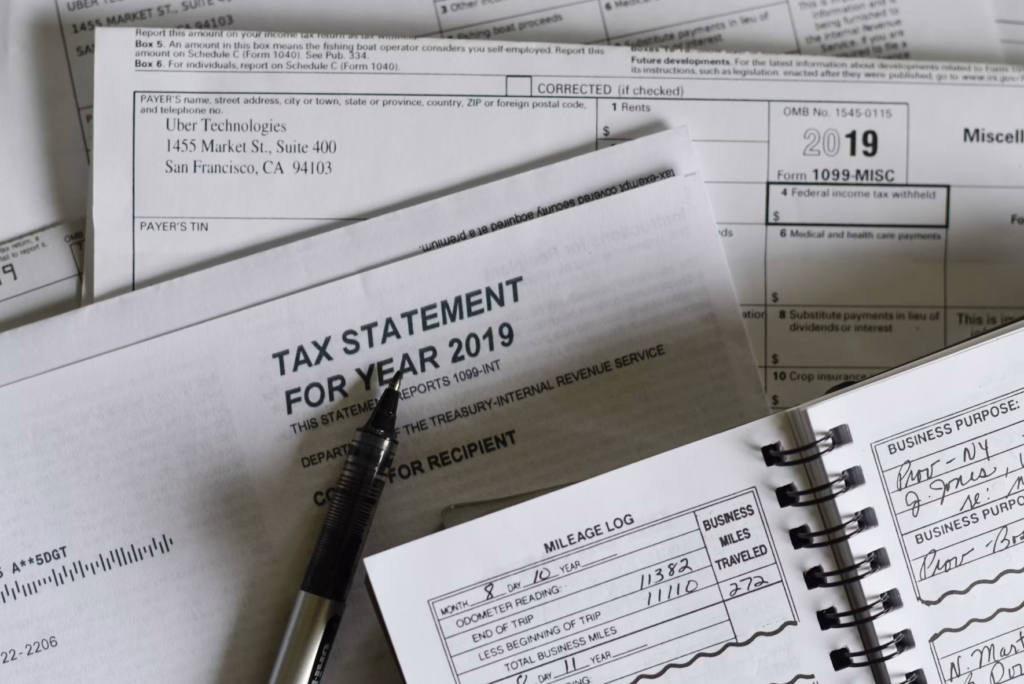
| Document | What it is and where to get it |
| W-2 form | Shows wages paid and taxes withheld by your employer. You receive this by January 31. Check your work email or HR portal. |
| 1099-NEC or 1099-K | For gig work, freelance, or contract income. DoorDash, Uber, Instacart, Etsy all send these. Due by January 31. |
| 1098-E | Student loan interest paid during the year. Your loan servicer sends this. You can deduct up to $2,500. |
| 1098-T | Tuition paid — needed to claim the American Opportunity Tax Credit (worth up to $2,500). Your school sends this. |
| Social Security Number | Required. Your SSN or Individual Taxpayer Identification Number (ITIN). |
| Bank account info | Routing + account number for direct deposit. Getting your refund directly deposited is faster than a check. |
| Prior year AGI | If you filed before: your Adjusted Gross Income from last year’s return. Used to verify your identity. First-time filers: enter $0. |
W-2 vs 1099 — What’s the Difference?

This is the question most first-timers don’t know to ask. It affects how complicated your taxes are and how much you owe.
| W-2 employee | 1099 / self-employed | |
| Who sends it | Your employer | Clients, platforms (DoorDash, Etsy, etc.) |
| Taxes withheld | Yes — employer withholds federal, state, Social Security, Medicare | No — you owe it all yourself |
| Tax complexity | Simple — software fills in most fields from your W-2 | More complex — must report income, track deductions, pay self-employment tax |
| Self-employment tax | Employer pays half (7.65%). You pay the other half via withholding. | You pay ALL 15.3% self-employment tax (Social Security + Medicare) |
| Typical outcome | Usually get a refund if you worked all year | Often OWE money — set aside 25-30% of gig income throughout the year |
Gig workers: if you earned $400+ through DoorDash, Instacart, Uber Eats, or any freelance work in 2026, you owe self-employment tax of 15.3% on that income PLUS regular income tax. If you didn’t set money aside during the year, you may owe a lump sum in April. See gig work income for what gig workers earn and tax considerations for each platform.
Free Filing Options — Most First-Timers Don’t Need to Pay

Filing taxes costs nothing if you use the right tools. Most young adults qualify for completely free filing.
| Option | Income limit | Best for |
| IRS Free File | Under $79,000 | Best option if you qualify. Multiple software partners, truly free federal filing. |
| TurboTax Free | Simple returns | W-2 income only, no investments, no self-employment. Good interface. |
| H&R Block Free | Simple returns | Similar to TurboTax Free. Also allows student loan interest deduction. |
| FreeTaxUSA | Any income | Truly free federal filing for any income level. Small fee for state returns. |
| VITA (in person) | Under $67,000 | IRS-certified volunteers file for free in person. Great if you want help. |
| Cash App Taxes | Any income | Completely free federal + state. Handles most situations including self-employment. |
The IRS Free File program is the most reliable free option — it uses commercial tax software partners but the federal return is genuinely free at any qualifying income level. Go to IRS.gov/FreeFile to access it. Do not Google “Free File” — fake sites appear in search results. Go directly to IRS.gov.
Never use a tax preparer who charges a percentage of your refund. This is predatory and costs you money you don’t need to spend. Free filing handles the same taxes.
Filing Your Return — Step by Step

Step 1: Gather All Documents
Collect everything from the documents table above before starting. Having everything in hand prevents the most common frustration: stopping halfway through to find a form.
Step 2: Choose Your Filing Software
For most first-time filers with W-2 income only: TurboTax Free, H&R Block Free, or Cash App Taxes. For gig workers or more complex situations: FreeTaxUSA handles self-employment for free.
Step 3: Enter Your Personal Information
Name, SSN, date of birth, address, filing status. As a single person under 65 with no dependents: file as Single. If your parents can claim you as a dependent (you live with them, they support you financially): check “Can be claimed as a dependent” — this affects some credits.
Step 4: Enter Your Income
W-2 income: The software will ask you to enter the boxes from your W-2. Box 1 = wages. Box 2 = federal taxes withheld. Box 17 = state taxes withheld. Enter exactly what’s on the form.
1099 income: Enter each 1099 separately. Self-employment income goes on Schedule C. The software walks through this automatically.
Other income: Bank interest (check your bank’s 1099-INT), investment income, unemployment benefits (1099-G) — all taxable and all must be reported.
Step 5: Take Your Deductions
Most first-time filers take the standard deduction — a flat amount that reduces your taxable income without itemizing. For 2026, the standard deduction is $14,600 for single filers. You only itemize if your deductions (mortgage interest, charity, medical) exceed $14,600 — which almost no young renter does.
Even with the standard deduction, claim these above-the-line deductions:
- Student loan interest: Up to $2,500 deduction if you paid interest on student loans. See student loan interest deduction.
- American Opportunity Tax Credit (AOTC): Up to $2,500 credit (not deduction — better!) if you’re in your first 4 years of college. Need Form 1098-T from your school.
- Earned Income Tax Credit (EITC): If your income is low (under $18,591 for single filers in 2026), you may qualify for EITC — a refundable credit worth up to $632 for single no-children filers.
- Roth IRA contribution: Not deductible (Roth uses after-tax dollars) — but if you contributed to a traditional IRA, you may get a deduction. See Roth IRA contribution.
Step 6: Review and File
The software shows your refund or amount owed before you file. Review it. Common errors to check: SSN matches your Social Security card exactly, bank routing/account numbers are correct, all income sources are included.
E-file (electronic filing) is faster than mailing — refunds typically arrive in 10-21 days via direct deposit versus 4-8 weeks by mail check.
Deductions and Credits First-Time Filers Most Often Miss

| Credit or deduction | Max value | Who qualifies |
| American Opportunity Tax Credit | $2,500/yr | First 4 years of college. Need 1098-T. Income under $90,000 (single). |
| Lifetime Learning Credit | $2,000/yr | Any college years beyond first 4. Graduate students qualify. |
| Student loan interest | $2,500/yr | Paid interest on qualified student loans. Income under $90,000 (single). |
| Earned Income Tax Credit | Up to $632 | Low income, no children. Income under $18,591 (single, 2026). |
| Saver’s Credit | Up to $1,000 | Contributed to a retirement account. Income under $36,500 (single, 2026). |
| Mileage deduction (gig workers) | Varies | If you drove for DoorDash, Instacart, etc. Track miles driven for work. |
The AOTC alone can reduce your tax bill by $2,500 — or if your tax liability is under $2,500, you get 40% of the unused credit back as a refund. This is the most valuable credit available to most 18-22 year olds. According to the IRS, millions of eligible students fail to claim education credits each year.
Gig Worker Taxes — What Instacart, DoorDash, and Uber Eats Workers Owe
If you earned gig work income or any other self-employment income in 2026, your tax situation is more complex than a W-2 employee:
- Report ALL income: Every dollar earned through gig platforms — even if you didn’t receive a 1099-K (platforms only send 1099-K if you earned $5,000+, but you owe taxes on all income regardless).
- Self-employment tax: 15.3% on net self-employment income (after deductions). This covers Social Security and Medicare taxes that employees split with their employer.
- Deductible expenses: Mileage ($0.67/mile for 2026), phone costs (work %), insulated bags for delivery, parking fees. These reduce your taxable gig income.
- Quarterly estimated taxes: If you owe more than $1,000 in taxes from self-employment, the IRS expects quarterly payments (April 15, June 15, September 15, January 15). Missing these results in a small penalty.
Rule of thumb: set aside 25-30% of every gig payment for taxes. For side income from gig work, expect to owe $250-300 in taxes.
What Happens If You File Late or Miss the Deadline

| Situation | What happens |
| File extension (Form 4868) | Gives you until October 15 to file. Free to request. Does NOT extend the deadline to pay — if you owe, pay by April 15 or face interest charges. |
| File late and owe money | Failure-to-file penalty: 5% per month, max 25%. Failure-to-pay penalty: 0.5% per month. Interest also accrues. File as soon as possible to minimize these. |
| File late but owe nothing (refund) | No penalty for filing late if you’re owed a refund. But you have 3 years to claim your refund — after that, the IRS keeps it. |
| Never filed before and missed years | File back years as soon as possible. The IRS rarely prosecutes first-time late filers. File, pay what you owe, and move forward. |
FAQs
Do I need to file taxes if I only worked part-time?
It depends on your total income. According to the IRS, single filers under 65 must file if gross income exceeds $14,600 in 2026. If you earned less than that, you’re not required to file — but you should if taxes were withheld from your paycheck. Filing a return is how you get those withheld taxes back.
How do I file taxes for the first time with no experience?
Use free tax software. For W-2 income only (one job, no investments, no self-employment): TurboTax Free, H&R Block Free, or Cash App Taxes all guide you step-by-step. Have your W-2, SSN, and bank account info ready. The entire process takes 30-45 minutes. If you want free in-person help, the CFPB has a VITA locator tool to find free tax prep sites near you.
What is the standard deduction for 2026?
The standard deduction for single filers in 2026 is $14,600. This is a flat amount that reduces your taxable income without requiring you to itemize individual expenses. Almost all young adults with no mortgage take the standard deduction — itemizing only makes sense if your deductible expenses (state taxes, charity, mortgage interest) exceed $14,600, which is rare for renters under 25.
Can I file taxes for free?
Yes — most first-time filers can file completely free. If your income is under $79,000, the IRS Free File program provides free federal filing through partner software. Cash App Taxes and FreeTaxUSA offer free federal filing at any income level. State filing is free in some states and costs $10-20 in others.
What if I made money from a side hustle or gig work?
Report all income — even without a 1099. Gig platforms like DoorDash and Instacart issue 1099-K for income over $5,000, but you owe taxes on all amounts. Self-employment income above $400 requires filing Schedule C. You can deduct business expenses including mileage ($0.67/mile in 2026), phone usage percentage, and other work-related costs. See gig work income for which platforms send tax forms and when.
The Bottom Line
Filing taxes for the first time is simpler than it looks. Gather your W-2 and any 1099 forms. Go to IRS Free File or Cash App Taxes. Follow the prompts. The software handles the math.
The two most common mistakes: not filing because you think you don’t owe anything (you might be owed a refund), and not claiming education credits like the AOTC (worth up to $2,500 for college students).
After filing, if you got a refund, resist the urge to spend it. The best use of a tax refund: fund your financial goals for your 20s — top up your emergency fund, pay down high-interest debt, or put it into your Roth IRA before the April 15 contribution deadline.
Sources
1. IRS — Free File program for federal tax filing
2. IRS — filing requirements and income thresholds
3. IRS — Earned Income Tax Credit information
4. Consumer Financial Protection Bureau — tax preparation resources